← Back to Lessons
Duas and Where They Come From

Twelve Angels and the Opening Dua

A beautiful story from the time of the Prophet ﷺ about the dua we say right after the takbir.

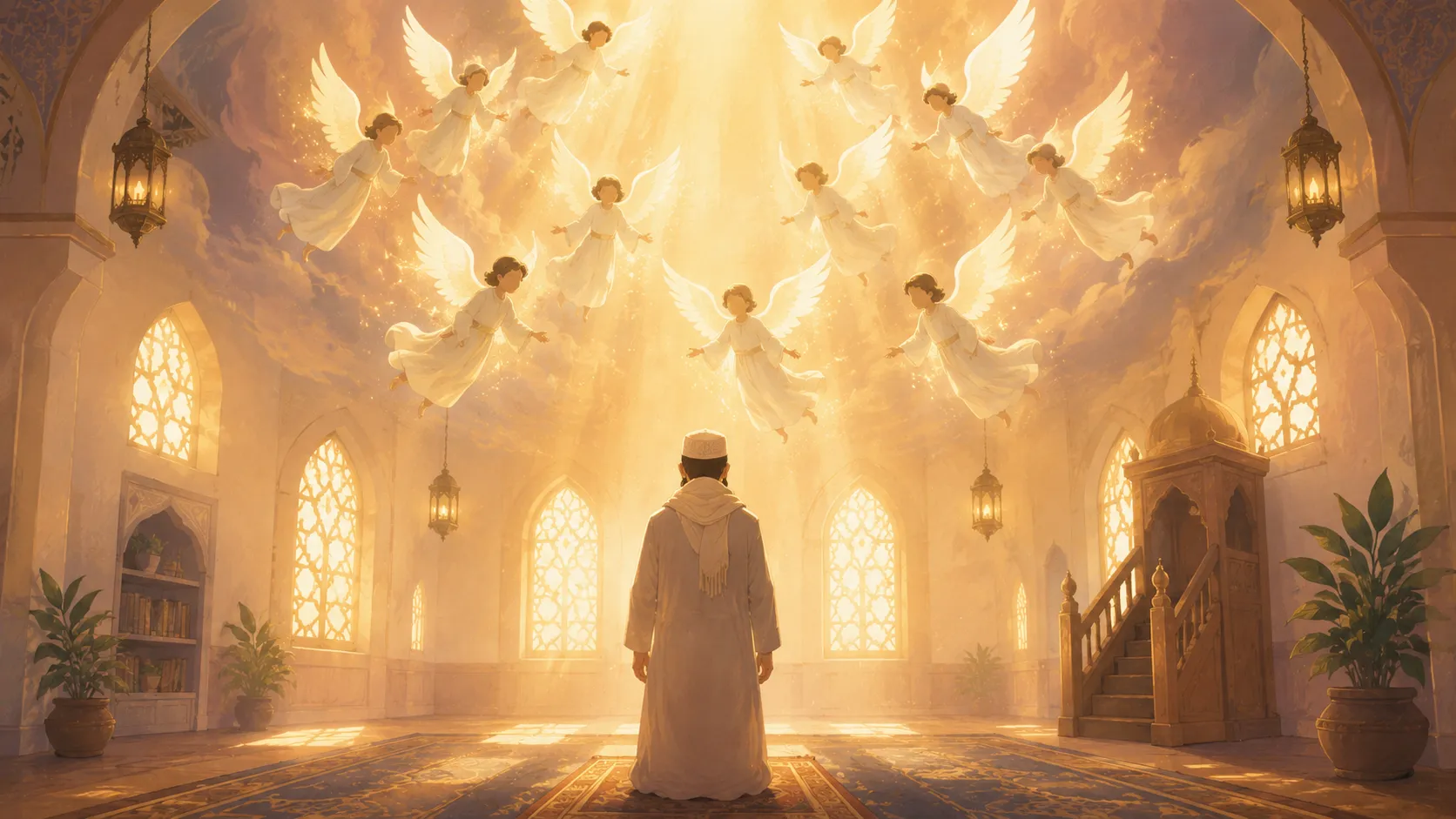
Twelve angels rushing toward heaven to carry a worshipper’s dua, illustrating the hadith of the opening dua in the prayer narrated by Abdullah ibn Umar
Listen
0:00

One day in the city of Madinah, the Prophet Muhammad ﷺ was leading the prayer at the mosque. The Muslims were all standing in neat rows behind him, ready to begin.

While they were praying, a man hurried into the mosque. He was late, but he wanted to catch the prayer. He quickly joined the back row, raised his hands, and said "Allahu Akbar" to enter the prayer.

Then, before reciting Al-Fatiha, the man said something very special. Quietly, from his heart, he said:

The Dua He Said
اللَّهُ أَكْبَرُ كَبِيرًا
Allahu akbaru kabira
Allah is the Greatest, abundantly.
وَالْحَمْدُ لِلَّهِ كَثِيرًا
wal-hamdulillahi kathira
And all praise is for Allah, abundantly.
وَسُبْحَانَ اللَّهِ بُكْرَةً وَأَصِيلًا
wa-subhanallahi bukratan wa-asila
And glory be to Allah, morning and evening.

When the prayer ended, the Prophet ﷺ turned to face the worshippers. He asked, "Who said those words?"

The man was a little nervous. The Prophet ﷺ was the most important person there, and he had noticed him. The man answered quietly, "It was me, O Messenger of Allah. I did not mean any harm by it."

The Prophet ﷺ smiled. Then he told the man something amazing. He said that those simple words were so beautiful that twelve angels had rushed forward, each one wanting to be the angel chosen to carry that dua up to Allah.

Twelve angels! Racing toward heaven, just to carry three short sentences of praise.

This is the dua we say in our prayer right after the takbir, before we begin Al-Fatiha. When you say it, remember the man in Madinah, and remember that beautiful words to Allah are never small. Even short ones can bring angels closer.

What this story teaches us

Allah loves when we praise Him with sincerity. The words don't need to be long or fancy. A short, heartfelt dua said with love can be so beautiful that angels race to bring it to Allah.

From a hadith narrated by Abdullah ibn Umar (may Allah be pleased with him), recorded in Sahih Muslim, Book of Prayer (Kitab as-Salah).

Practice this dua in your prayer

You can say this opening dua right after the takbir in any of the five daily prayers. Pick one to practice with Sofia:

Read more lessons

For Parents

Notes on this lesson and its source.

What is the opening dua in Islamic prayer?

The opening dua, also called the istiftah dua, is a short supplication said quietly at the very beginning of the Islamic prayer (salah), right after the opening takbir ("Allahu Akbar") and before reciting Surah Al-Fatiha. There are several authentic versions taught by the Prophet Muhammad ﷺ to his companions. One of the most well-known is "Subhanaka Allahumma wa bihamdika, wa tabarakas-muka, wa ta‘ala jadduka, wa la ilaha ghayruk" (Glory and praise to You, O Allah, blessed is Your name and exalted is Your majesty, there is no god besides You). The opening dua is a brief moment of praise that sets the heart for the prayer ahead.

Why did twelve angels rush to carry the man’s dua?

According to the hadith, the Prophet Muhammad ﷺ said that when the man spoke those words of praise, twelve angels rushed forward, each one wanting to be the angel chosen to carry the dua up to Allah. The number twelve highlights how much Allah loves words of sincere praise. The story is a powerful teaching for children: even short, simple words said with a sincere heart can have an enormous impact in the unseen world. The angels were not impressed by length or eloquence, they were drawn to the sincerity and beauty of the dua.

Where in the hadith is the story of the twelve angels?

This hadith is recorded in Sahih Muslim, one of the two most trusted hadith collections in Sunni Islam. The narration in this lesson follows the version reported through Abdullah ibn Umar (may Allah be pleased with him), one of the most well-known companions of the Prophet Muhammad ﷺ. The hadith appears in the Book of Prayer (Kitab as-Salah). Sahih Muslim was compiled by Imam Muslim ibn al-Hajjaj in the 9th century CE and is widely considered the second most authentic hadith collection after Sahih al-Bukhari.

What is the source of this hadith?

The story is taken from a hadith narrated by Abdullah ibn Umar (may Allah be pleased with him) and recorded in Sahih Muslim, Book of Prayer. Hadith collections are records of the sayings and actions of the Prophet Muhammad ﷺ, preserved through chains of trusted narrators over many generations. Sahih Muslim is considered one of the most authentic collections in Islam. The story has been retold for centuries to teach children about the power of sincere praise.

Is this the opening dua we should teach kids?

The most commonly taught opening dua for children is "Subhanaka Allahumma wa bihamdika, wa tabarakas-muka, wa ta‘ala jadduka, wa la ilaha ghayruk" because it is short, rhythmic, and easy to memorize. Different Muslim communities and schools of thought may use slightly different versions of the istiftah dua, all of which are taken from authentic hadith. If your family or local masjid uses a specific version, that is the one to teach. The story of the twelve angels is wonderful for any version, because the point of the story is that Allah loves sincere praise, not any particular set of words.

How can I use this story with my child?

This story is perfect for teaching children that the small things they say to Allah matter enormously. After reading, you might ask: "How do you think the man felt when the Prophet smiled at him?" or "Why do you think the angels were so excited about those simple words?" The story is also a beautiful way to introduce the istiftah dua itself, especially for children who are just learning the steps of salah. You can practice the dua together right after the takbir during your next prayer at home, and remind your child that twelve angels once raced to carry words just like these to Allah.