← Back to Lessons
Stories of the Prophet ﷺ

The First Revelation in Hira

Alone in a quiet cave, the Prophet ﷺ heard one word that changed the whole world: Read.

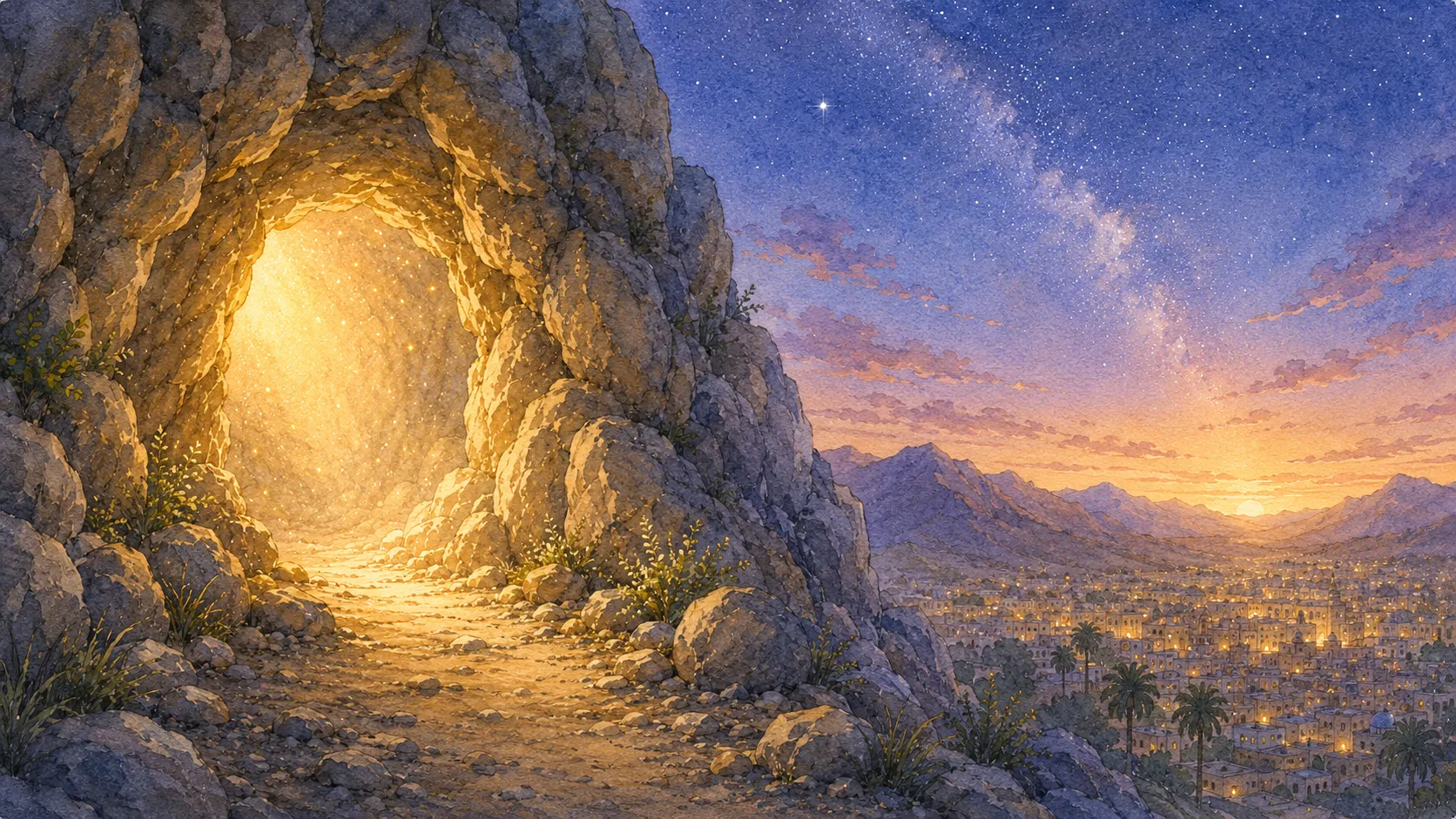
The glowing mouth of the cave of Hira high on a mountain at dawn, looking out over the lights of Mecca and the mountains beyond
Listen
0:00

Before he was a prophet, Muhammad ﷺ was already the most trusted man in Mecca. People called him Al-Amin — "the trustworthy one." If you had something precious, you left it with him.

But Muhammad ﷺ was troubled by what he saw around him. People were worshipping statues. The strong were unkind to the weak. Something felt wrong, and he wanted to think about Allah quietly, away from all the noise.

So he would climb a mountain outside Mecca to a small cave called Hira. It was a hard climb. He would stay there for days, thinking and praying, with a little food and water. From up there he could see the whole city below him.

Then one night in Ramadan, when he was forty years old, something happened that had never happened to anyone in Mecca before.

The angel Jibreel came to him — a real angel, right there in the little cave — and said one word:

"Iqra." Read.

Muhammad ﷺ had never learned to read. So he answered honestly: "I am not a reader."

The angel held him close and said it again. "Iqra." And again Muhammad ﷺ said, "I am not a reader."

A third time, the angel held him and said:

"Read, in the name of your Lord who created — created the human being from a clinging clot. Read, and your Lord is the Most Generous, who taught by the pen, taught the human being what he did not know."

And this time the words stayed. They went into his heart and he could say them. Those were the very first verses of the Quran ever revealed — the beginning of Surah Al-Alaq.

Muhammad ﷺ hurried down the mountain, his heart pounding. He did not fully understand yet what had happened to him. But the whole world had just changed, and it started with one word in a quiet cave: Read.

What this story teaches us

Think about the very first word Allah chose to send to us. Not "fight," not "build," not "pay." Read. Learn. Allah opened His whole message with an invitation to know things — and He described Himself as the One "who taught by the pen, taught the human being what he did not know." Every time you read something good, or learn something new, or ask a question because you truly want to understand, you are answering that very first word.

From The hadith of the first revelation in Sahih Bukhari and Sahih Muslim, and Surah Al-Alaq (96) of the Quran.

Try it today

Today, answer that first word. Read something — a page of a book, a surah, a story with someone you love — and before you start, say "Bismillah" and remember Who taught you how to learn.

Read more lessons

For Parents

Source, context, and how to share this story with your child.

What was the cave of Hira?

Hira is a small cave near the top of Jabal an-Nour, the Mountain of Light, a few kilometres outside Mecca. It is a genuinely difficult climb, and the cave itself is tiny — barely big enough to lie down in. The Prophet ﷺ used to go there alone, sometimes for several days at a time, to think and to worship Allah away from the idols and noise of the city. It is still there today, and pilgrims often climb up to see it.

What does 'Iqra' mean?

Iqra (اقرأ) is an Arabic command meaning 'read' or 'recite.' It is the first word of the Quran ever revealed, and it gives Surah Al-Alaq (chapter 96) its opening. The choice of word is deeply significant: the very first thing Allah said to His final Messenger was an instruction to read and to learn, and the passage goes on to mention the pen and the teaching of what people did not know.

Why did the Prophet ﷺ say 'I am not a reader'?

Because it was simply true. The Prophet ﷺ was unlettered — he had never been taught to read or write. When the angel told him to read, he answered honestly that he could not. Muslims consider this an important part of the story: the Quran did not come from a man who had studied books, which is part of the evidence that it came from Allah rather than from himself.

Was the Prophet ﷺ frightened?

Yes, and the sources say so plainly, which is worth sharing with children rather than hiding. He had just seen an angel; anyone would be shaken. He came down the mountain trembling and went straight to his wife Khadijah, asking her to cover him with a blanket. It is a very human moment, and it makes the next part of the story — how Khadijah comforted him — one of the most beloved in the seerah.

How old was the Prophet ﷺ when this happened?

He was forty years old. The revelation came during the month of Ramadan, on the night that Muslims know as Laylat al-Qadr, the Night of Decree, which Surah Al-Qadr describes as better than a thousand months. From that night, revelation continued to come to him gradually over roughly twenty-three years until the Quran was complete.

How can I teach this story to my child?

Lead with the wonder of it: a quiet cave, a man alone, and then an angel. Then land on the first word. Ask your child, "If you could send the whole world one word to start with, what would you pick?" and let them sit with the fact that Allah picked Read. It is a wonderful way to connect learning at school, reading at bedtime, and their Quran lessons to something much bigger than homework.