← Back to Lessons
Duas and Where They Come From

What We Say When We Leave Home

Ten seconds at the front door, and you walk out guided, protected, and defended.

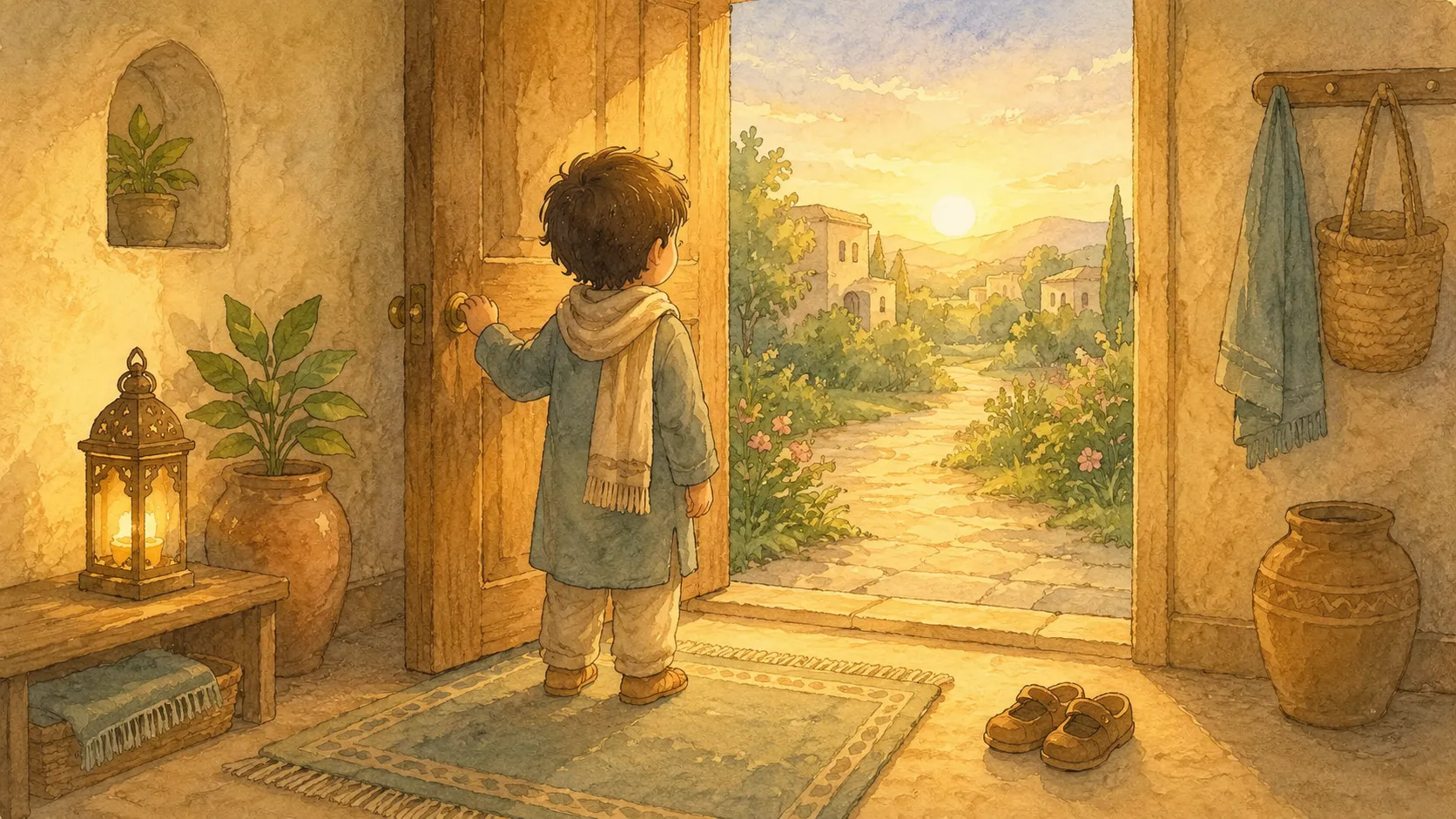
A young boy standing at an open front door with his hand on the handle, looking out at a sunlit path leading away from the house
Listen
0:00

Think about how many times you walk out of your front door. School. The park. The shop. Your grandmother's house. You do it without thinking — grab your shoes, open the door, gone.

The Prophet ﷺ taught us something to say in that exact moment. It takes about ten seconds. And the promise attached to it is enormous.

The Dua at the Door
بِسْمِ اللَّهِ
Bismillah
In the name of Allah.
تَوَكَّلْتُ عَلَى اللَّهِ
tawakkaltu 'alallah
I put my trust in Allah.
وَلَا حَوْلَ وَلَا قُوَّةَ إِلَّا بِاللَّهِ
wa la hawla wa la quwwata illa billah
And there is no power and no strength except with Allah.

Look at what you just said, piece by piece.

"Bismillah" — I am not starting this on my own. Whatever is out there today, I go in Allah's name.

"Tawakkaltu 'alallah" — I am handing the worrying part to Allah. I will still do my best. But I am not carrying the whole world on my shoulders, because I do not have to.

"Wa la hawla wa la quwwata illa billah" — this one is the biggest. It means I have no power at all, except what Allah gives me. Not the strength in your legs, not the ideas in your head, not your ability to be brave — none of it is yours. It is all borrowed from Allah, and He is happy to keep giving it.

Now here is the promise. The Prophet ﷺ said that when someone says this as they leave their house, it is said to him:

"You are guided. You are protected. You are defended."

Three things, for ten seconds of words. Guided — you will be shown the right way. Protected — you are looked after. Defended — something is on your side.

And the Prophet ﷺ added one more thing: the shaytan turns away from that person. He backs off, because there is nothing for him to do with someone who just handed everything to Allah.

What this story teaches us

This dua is a tiny lesson in tawakkul — trusting Allah. Notice that it does not say "I will not bother trying." You still put your shoes on. You still walk to school. You still do your best when you get there. Trusting Allah means doing your part and letting Him carry the part you were never strong enough to carry anyway. Ten seconds at the door, and you go out lighter than you came.

From Sunan Abi Dawud and Jami at-Tirmidhi, from the hadith of Anas ibn Malik (may Allah be pleased with him).

Try it today

Today, try it for real. Tomorrow morning, before you step outside, stop with your hand on the door handle and say it: Bismillah, tawakkaltu 'alallah, wa la hawla wa la quwwata illa billah. Do it every day for a week and it will start saying itself.

Read more lessons

For Parents

Source, context, and how to share this story with your child.

What is the dua for leaving the house?

The dua is: Bismillah, tawakkaltu 'alallah, wa la hawla wa la quwwata illa billah — "In the name of Allah, I put my trust in Allah, and there is no power and no strength except with Allah." It is short enough that most children can learn it in a day or two, and it is said as you leave your home.

Where does this dua come from?

It comes from a hadith narrated by Anas ibn Malik (may Allah be pleased with him), recorded in Sunan Abi Dawud and Jami at-Tirmidhi. The Prophet ﷺ said that when a person leaves his house and says these words, it is said to him: "You have been guided, you have been sufficed, and you have been protected," and the devil turns away from him. Scholars have graded the report as authentic (sahih), and it is one of the most widely taught daily duas.

What does 'la hawla wa la quwwata illa billah' mean?

Literally it means "there is no power and no strength except with Allah." It is an acknowledgement that every ability we have — to move, to think, to choose, to endure — is given to us by Allah moment by moment, and is not ours by right. The Prophet ﷺ called it a treasure from the treasures of Paradise. It is also a wonderfully calming thing to say when something feels beyond you, which is exactly why it belongs in a dua said on the way out into the world.

What does the dua promise?

Three things, in the words of the hadith: that you are guided, that you are sufficed or taken care of, and that you are protected — and that the shaytan withdraws from you. It is worth being clear with children about what this does and does not mean. It is not a magic shield against ever having a bad day. It is Allah's promise of guidance and care for someone who begins their day by handing it to Him.

When exactly should my child say it?

As they leave the house — hand on the door, shoes on, about to step out. The physical trigger is what makes it stick: the door itself becomes the reminder. Some families say it together at the door before the school run, which works well because children learn duas far faster by hearing them said out loud in context than by memorising them from a page.

How can I help my child remember it?

Attach it to the action rather than to a lesson. Say it out loud yourself every single time you leave — children copy what they see far more than what they are told. For the first week, pause at the door and say it together. After that, try stopping and just looking at them expectantly; most children will fill in the words themselves. Ten seconds a day, and by the end of a month it is a habit for life.