Ready to practice Maghrib?
Sofia will recite while you follow along with Layth. Just listen, watch, and try the movements with us. Takes about 6 minutes.
Practice MaghribWhat is Maghrib?
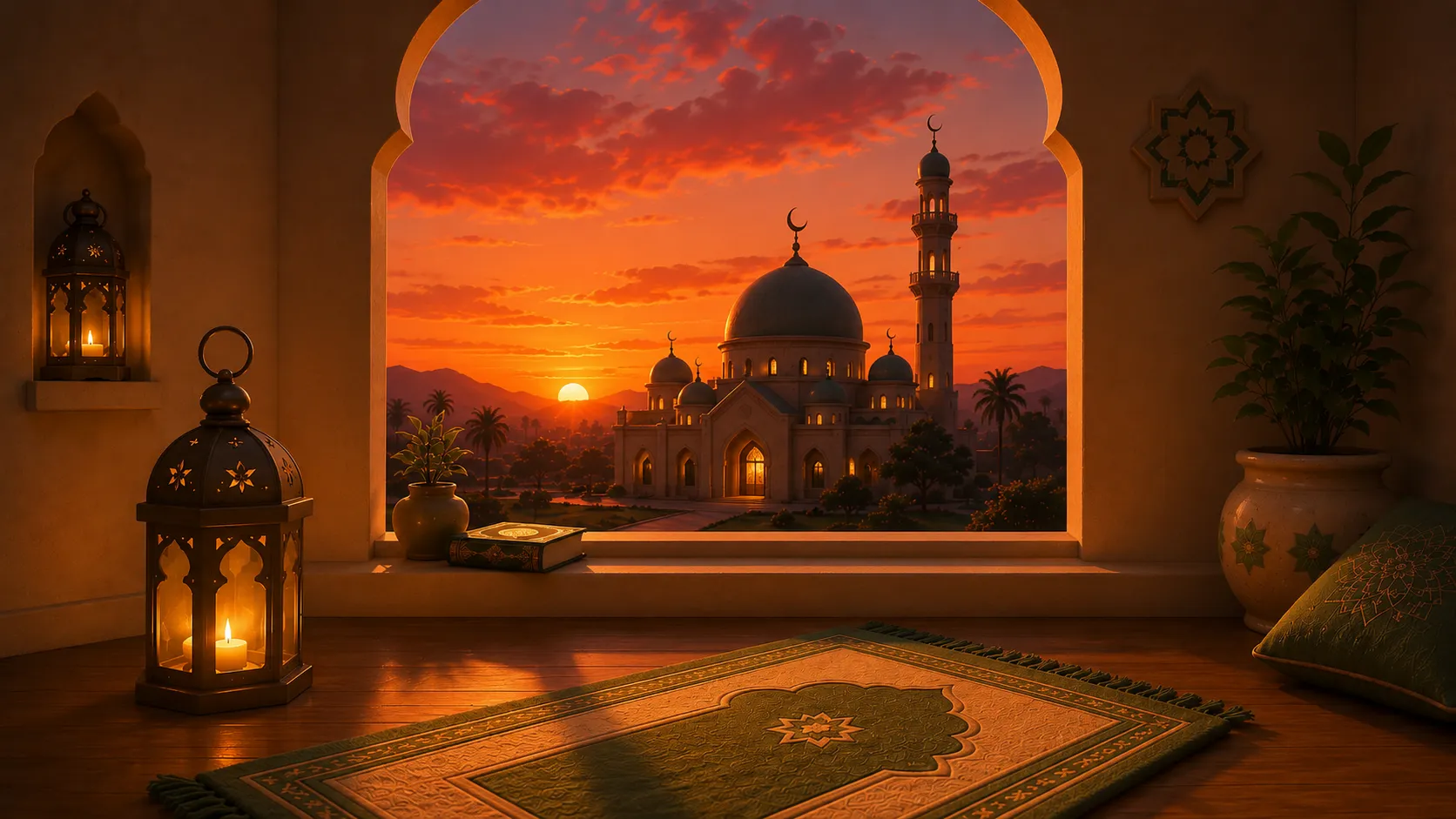
Maghrib is the sunset prayer. We pray it right after the sun goes down, when the sky is still glowing orange and pink. It is the fourth prayer of the day, coming after Asr and before Isha.
Maghrib has 3 rakat, which makes it special: it is the only obligatory daily prayer with an odd number of rakat. The other prayers are all 2 or 4 rakat. The first two rakat are recited aloud, and the third rakat is silent. This loud-then-quiet pattern matches Isha.
Maghrib has the shortest window of all five daily prayers. It only lasts about an hour or so, until the orange light at the edge of the sky has completely faded into night. Because the window is short, Maghrib is the prayer that teaches us most about not delaying. Many families pray Maghrib right when they hear the adhan, before sitting down to dinner.
What you'll recite
Every rakat begins with Al-Fatiha (the opening of the Quran). In Maghrib, you only add a short surah after Al-Fatiha in the first two rakat. In rakat three, you say Al-Fatiha by itself. The first two rakat are said aloud; the third is said quietly to yourself.
You get to choose which surah comes after Al-Fatiha in the first two rakat. When you tap practice, you'll pick from the surahs you have learned. Here's what each rakat looks like:
- Al-Fatiha
- Your chosen surah
- Al-Fatiha
- Your chosen surah
- Al-Fatiha (just by itself)
Short surahs like Al-Ikhlas, An-Nas, and Al-Falaq are great choices, and it's nice to pick a different one for the second rakat.
After the second rakat, you sit for a short moment to say the tashahhud, then stand back up for the third rakat. The full sitting with tashahhud, durood, and salaam happens at the very end, after the third rakat.
Haven't learned the basics yet?
If you don't know how to pray one rakat yet, that's okay! Start with the Start Here lesson first. Layth and Sofia will teach you each posture and recitation, one step at a time.
Once you've learned one rakat, you'll be ready to practice any of the five daily prayers.
Ready to give it a try?
Practice MaghribQuestions parents ask
How many rakat is Maghrib?
Maghrib is 3 rakat. It is the only obligatory daily prayer with an odd number of rakat. The first two rakat each include Al-Fatiha followed by a short surah of your choice, both recited aloud. After the second rakat the worshipper sits for the first tashahhud, then stands again. The third rakat contains Al-Fatiha only, recited silently, with no surah added after it. The prayer ends with a final sitting that includes the tashahhud, the durood, and salaam to the right and then to the left.
When do Muslims pray Maghrib?
Maghrib is prayed right after sunset, as soon as the sun has fully disappeared below the horizon. The window is the shortest of the five daily prayers, lasting only until the red light of twilight fades from the sky (when Isha begins). This is typically about 60 to 90 minutes, depending on the season and location. Because the window is short, Maghrib is often considered the most time-sensitive of the daily prayers. Most Muslim families use a prayer time app or website to know the precise minute of sunset each day.
Why is Maghrib only 3 rakat?
Maghrib is the only obligatory prayer with 3 rakat. The other prayers are 2 rakat (Fajr) or 4 rakat (Dhuhr, Asr, Isha). The reason for the 3-rakat structure has been discussed by scholars over centuries, with no single definitive answer. Some scholars note that Maghrib falls between the day and the night, and its odd number of rakat reflects this transitional position. Others observe that the Prophet Muhammad (peace be upon him) was taught this structure by the angel Jibreel (Gabriel) and the wisdom behind it belongs to Allah. What matters in practice is that Maghrib is prayed as 3 rakat: two with a chosen surah, and one with only Al-Fatiha.
What surahs do you recite in Maghrib?
In Maghrib, only the first two rakat add a short surah after Al-Fatiha. The choice of short surah is up to the worshipper. Common choices for children include Surah Al-Ikhlas, Surah An-Nas, and Surah Al-Falaq because they are short, easy to memorize, and frequently taught early. The third rakat of Maghrib contains Al-Fatiha only, with no surah added. This first-two-rakat-only pattern matches Dhuhr, Asr, and Isha.
Is Maghrib prayed silently or aloud?
Maghrib is a mixed prayer. The first two rakat are recited aloud: Al-Fatiha and the short surah are said audibly. The third rakat is silent: Al-Fatiha is said quietly to yourself, with no surah added. When an imam leads a congregation in Maghrib, the imam recites the first two rakat aloud so the worshippers can hear and follow along. Isha follows the same loud-then-silent pattern; Fajr is fully aloud; Dhuhr and Asr are fully silent. In the Layth and Layan practice mode, Sofia recites all rakats aloud so children can hear and learn the words.
Why is rakat 3 of Maghrib different from rakats 1 and 2?
In Maghrib, the first two rakat each include Al-Fatiha followed by a short surah of the worshipper's choice, while the third rakat contains Al-Fatiha alone with no additional surah. This is the standard structure for the rakats after the first two in obligatory prayers: a short surah is recited in the first two rakat only, and any later rakat is Al-Fatiha by itself. The movements (ruku and sujud) remain the same in every rakat.
Why is there a sitting in the middle of Maghrib?
After the second rakat of any obligatory prayer that has more than two rakat, the worshipper sits briefly to recite the first tashahhud. This first sitting includes only the tashahhud (the testimony of faith), not the durood (the blessings on the Prophet) and not the salaam. After the first tashahhud, the worshipper stands back up and continues with the next rakat. In Maghrib, the next rakat is the third and final rakat, and the full sitting with tashahhud, durood, and salaam comes at the end of that third rakat.
How long does Maghrib take?
Maghrib typically takes about 6 to 8 minutes when prayed alone at a calm, learning pace. A child praying along with the Layth and Layan guided practice can expect about 6 minutes. When prayed quickly, it can be as short as 4 minutes; when prayed slowly with longer surahs, it can take 10 minutes or more. Maghrib is shorter than Dhuhr, Asr, and Isha because it has 3 rakat instead of 4, but longer than Fajr which only has 2 rakat.