← Back to Lessons
Stories of the Companions

Bilal and the Rooftop Adhan

A young man who had been a slave became the first to call Muslims to prayer.

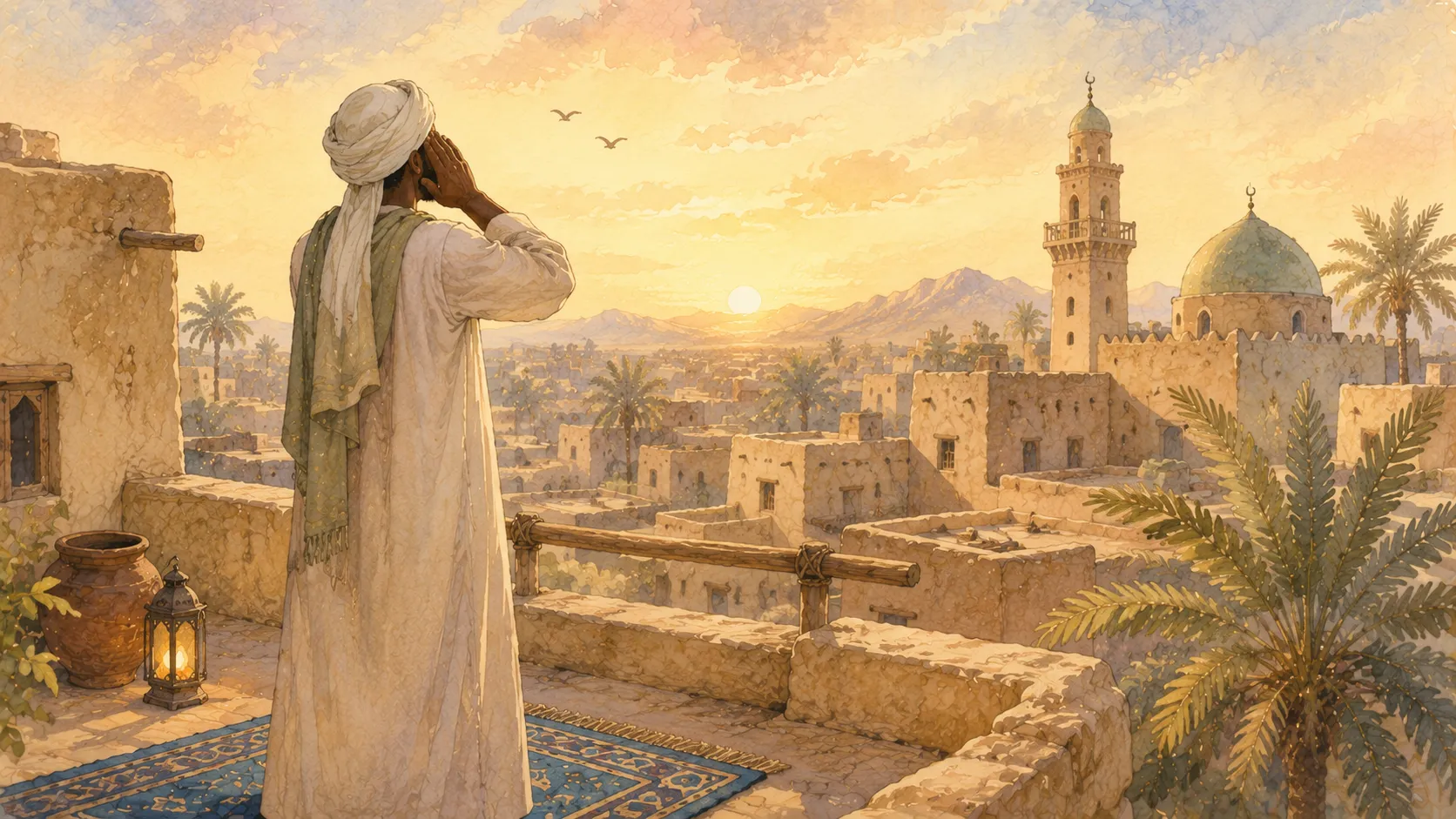
Bilal ibn Rabah, the first muezzin in Islam, standing on a rooftop at sunrise with hands raised to call the adhan in soft morning light
Listen
0:00

Long ago, in the city of Makkah, there lived a young man named Bilal. Bilal had been brought to Makkah as a slave from a faraway land. He worked hard, and his life was not easy.

When Bilal heard about Islam and the Prophet Muhammad ﷺ, his heart felt happy for the first time. He believed in one Allah. He chose to become a Muslim.

But Bilal's owner was a cruel man who did not believe in Islam. When he found out that Bilal was a Muslim, he became very angry. He hurt Bilal in the hot desert sun and tried to make him give up his faith.

Even when it was very hard, Bilal stayed strong. He kept saying one word: "Ahad. Ahad." It means "One. One." He was telling everyone that Allah is One, and he would never worship anyone else.

One day, a kind companion of the Prophet ﷺ named Abu Bakr saw what was happening to Bilal. Abu Bakr paid money to set Bilal free. From that day on, Bilal was no longer a slave. He was a free Muslim, and he was with the Prophet ﷺ and his friends.

Years later, the Muslims moved to a new city called Madinah. They needed a way to call everyone to come to the masjid for prayer. The Prophet ﷺ thought about it carefully. Then he chose Bilal for a very special job.

The Prophet ﷺ said that Bilal would be the first person to call the adhan, the call to prayer. Every day, five times a day, Bilal would climb up high and call out with his beautiful, strong voice: "Allahu Akbar! Allahu Akbar!"

Bilal had once been a slave. Now his voice was the voice that brought all the Muslims together to pray. The Prophet ﷺ loved him very much.

What this story teaches us

Allah does not care where you come from, what your skin color is, or whether your family is rich or poor. Allah cares about your heart and how strong your faith is. Bilal was a slave who became one of the most loved companions of the Prophet ﷺ. His voice still echoes today, every time a Muslim hears the adhan.

From the seerah (life of the Prophet ﷺ) as recorded in multiple authentic sources, including Sahih al-Bukhari and the biographical works of Ibn Ishaq and Ibn Hisham.

Try it today

The next time you hear the adhan, listen carefully. Remember that the first person to call it was Bilal, who had been a slave. His voice taught the whole world that Allah loves strong hearts.

Read more lessons

For Parents

Source, context, and how to share this story with your child.

Who was Bilal ibn Rabah?

Bilal ibn Rabah (also written Bilal al-Habashi) was a freed African slave who became one of the most beloved companions of the Prophet Muhammad ﷺ. Born in Makkah to enslaved parents originally from Abyssinia (modern-day Ethiopia), Bilal accepted Islam in its earliest days. He was tortured by his enslaver for his faith but never gave it up, repeating only one word: "Ahad" (One), affirming the oneness of Allah. Abu Bakr eventually paid to free him. The Prophet ﷺ chose Bilal to be the very first muezzin, the person who calls Muslims to prayer.

Why did Abu Bakr free Bilal?

Abu Bakr, the closest companion of the Prophet Muhammad ﷺ, used much of his personal wealth in the early days of Islam to free enslaved Muslims who were being tortured for their faith. When he saw Bilal being pressed under a heavy rock in the desert sun for refusing to give up Islam, Abu Bakr negotiated with the enslaver and bought Bilal's freedom. This act became a model of compassion and brotherhood in Islamic tradition. Abu Bakr did not free Bilal because of his race or background, but because Bilal was a fellow believer suffering for the truth.

Why was Bilal chosen as the first muezzin?

After the Muslims migrated to Madinah, they needed a way to gather everyone for prayer. The companions discussed various options, including bells or horns, before a companion named Abdullah ibn Zayd had a dream of the words of the adhan. The Prophet Muhammad ﷺ confirmed the dream and chose Bilal to be the one to call it because of his exceptionally beautiful and far-carrying voice. Choosing Bilal, a formerly enslaved Black African man, to give the most public daily voice of Islam was a powerful statement that in Islam, all people are equal in the eyes of Allah, regardless of race, origin, or wealth.

What is the source of this story?

The story of Bilal ibn Rabah is preserved in the seerah (the recorded biography of the Prophet Muhammad ﷺ) and across multiple authentic hadith collections, including Sahih al-Bukhari. The classical biography Sirat Rasul Allah by Ibn Ishaq, later edited by Ibn Hisham, records Bilal's torture, his freeing by Abu Bakr, and his role as the first muezzin. These accounts have been transmitted faithfully for more than 1,400 years and form a well-known part of Islamic history.

Why is Bilal's story so important in Islam?

Bilal's story is one of the most powerful illustrations of Islamic values. It shows that faith is stronger than oppression, that all people stand equal before Allah, and that a person's worth is measured by their heart, not their birth or status. The Prophet Muhammad ﷺ said about Bilal that he heard the sound of Bilal's footsteps in Paradise, an honor given to very few. For Muslim children of any background, Bilal's example is a reminder that Allah sees the heart and that nothing in the world is more important than holding on to faith.

How can I use this story with my child?

Bilal's story is especially powerful for children navigating questions about identity, belonging, fairness, or what to do when someone treats them unkindly. After reading, you might ask: "Why do you think Bilal kept saying 'Ahad'?" or "How do you think Bilal felt when Abu Bakr set him free?" The story also opens conversations about the adhan itself, your child can listen for it next time they hear the call to prayer and remember that Bilal's voice was the first to call out those same words more than 1,400 years ago.