← Back to Lessons
Stories of the Prophet ﷺ

The Thirsty Dog and the Well

A story the Prophet ﷺ told about one small act of kindness, and how Allah saw it.

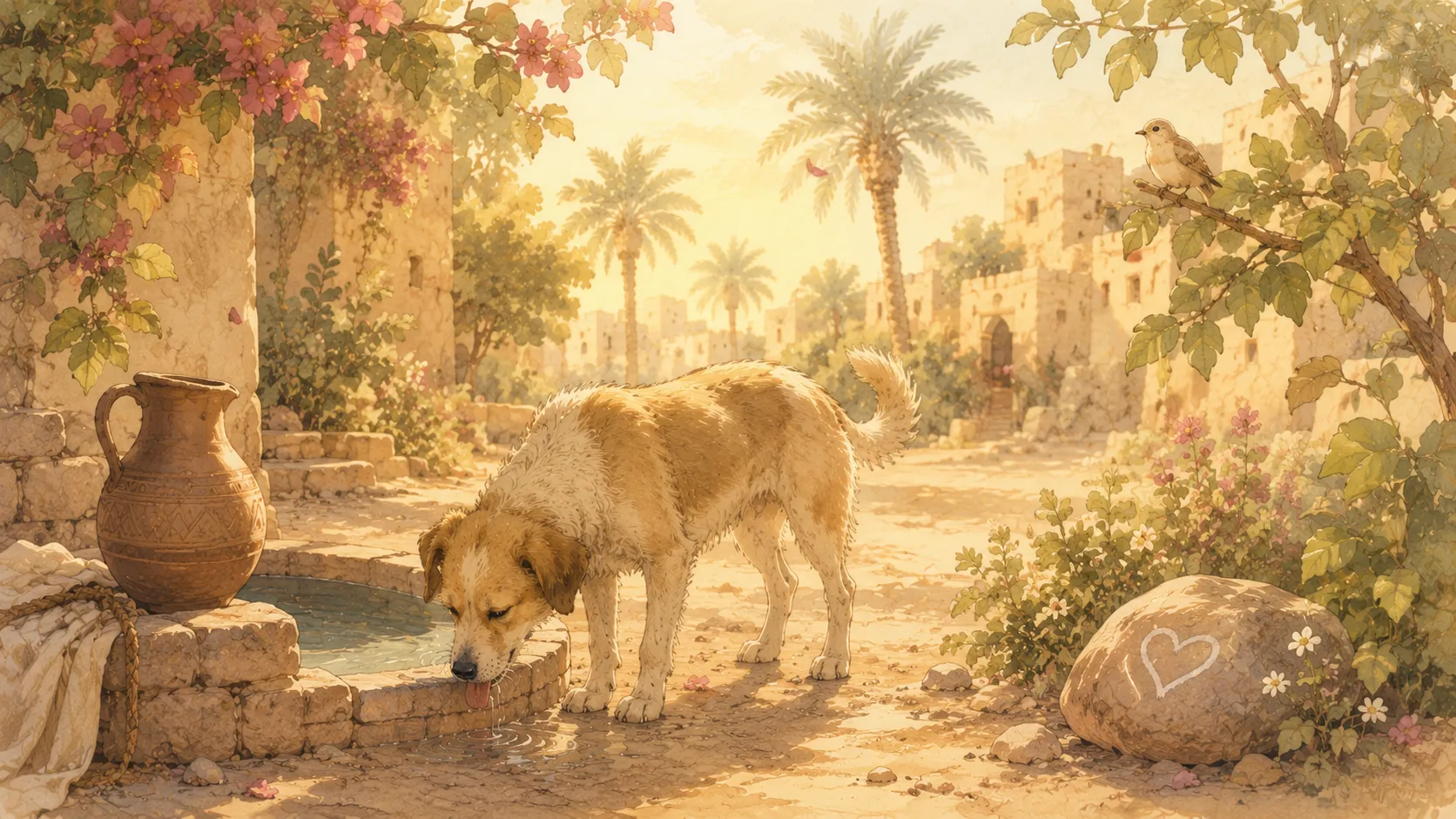
The thirsty dog drinking from water that a man brought up from a well in his shoe, illustrating the hadith of kindness to animals narrated by Abu Hurairah
Listen
0:00

Once, the Prophet Muhammad ﷺ told his companions a story about a man who was walking on a very hot day. The man became very thirsty.

He found a well, climbed all the way down inside, drank some cool water, and then climbed back out.

When he reached the top, he saw a dog. The dog was so thirsty that it was licking the wet sand around the well, hoping for water. The man knew exactly how that dog felt, because he had been just as thirsty a moment ago.

So the man climbed all the way back down into the well. He filled his shoe with water, held the shoe carefully in his teeth so he could climb with his hands, and brought the water up to the dog. The dog drank until it was no longer thirsty.

The Prophet ﷺ told his companions that Allah was so pleased with the man for that one act of kindness that Allah forgave his sins.

The companions were amazed. They asked, "O Messenger of Allah, do we get rewarded even for being kind to animals?"

The Prophet ﷺ answered, "Yes. In every living creature, there is a reward."

What this story teaches us

Even one small act of kindness to an animal matters to Allah. The man in this story wasn't perfect, but Allah saw his kindness in that moment and rewarded him for it. Every time we help an animal, Allah is watching with love.

From a hadith narrated by Abu Hurairah (may Allah be pleased with him), recorded in Sahih al-Bukhari and Sahih Muslim (mutafaq alayh, agreed upon by both collections).

Try it today

Today, find a way to help an animal in your neighborhood. You could put a small bowl of water outside for the birds, give your pet a treat, or just stop to notice an animal that often goes unnoticed.

Read more lessons

For Parents

Source, context, and how to share this story with your child.

What is the hadith of the thirsty dog?

The hadith of the thirsty dog is a famous teaching of the Prophet Muhammad ﷺ. The Prophet told his companions about a man on a hot day who climbed down into a well to drink water, then saw a thirsty dog licking the wet sand outside. The man climbed all the way back down, filled his shoe with water, carried it up in his teeth so his hands were free to climb, and gave the dog a drink. The Prophet said that Allah was so pleased with this act of kindness that He forgave the man's sins. When the companions asked if they were rewarded for kindness to animals, the Prophet answered: "In every living creature, there is a reward."

What does Islam teach about kindness to animals?

Islam teaches that kindness to animals is one of the most beloved acts in the sight of Allah. The Prophet Muhammad ﷺ taught that all animals are creations of Allah, that they have their own forms of worship, and that a Muslim is rewarded for every kindness shown to a living creature, even something as small as giving water to a thirsty animal. The Quran refers to animals as communities like our own. Cruelty to animals is forbidden in Islam, and several hadith warn against neglecting or harming animals in our care. The story of the thirsty dog is one of the most powerful examples of how a small act of mercy can earn enormous reward.

Where is the hadith of the thirsty dog recorded?

The hadith is recorded in both Sahih al-Bukhari and Sahih Muslim, the two most authentic and trusted hadith collections in Sunni Islam. It is narrated by Abu Hurairah (may Allah be pleased with him), one of the most prolific narrators of hadith among the companions of the Prophet Muhammad ﷺ. The hadith appears in the chapters on mercy, on the rewards of charity, and in some collections under the chapter on prophet Muhammad's sayings about animals. Being narrated in both Bukhari and Muslim gives this hadith the highest level of authenticity in Islamic tradition (mutafaq alayh, agreed upon by both).

What is the source of this hadith?

The story is taken from a hadith narrated by Abu Hurairah (may Allah be pleased with him) and recorded in both Sahih al-Bukhari and Sahih Muslim. Hadith collections are records of the sayings and actions of the Prophet Muhammad ﷺ, preserved through chains of trusted narrators over many generations. When a hadith appears in both Bukhari and Muslim, it carries the highest level of authenticity in Sunni Islamic scholarship. The story has been retold for centuries as a teaching about mercy, kindness to animals, and how Allah rewards even small acts of compassion.

Is it OK to have a dog in Islam?

Islamic scholars have a range of views on keeping dogs in the home. Most classical scholars agree that dogs may be kept for clear purposes such as guarding, herding, or assistance, citing several hadith that permit this. There are also hadith that mention angels not entering a house where a dog is kept as a pet. Different schools of thought (madhahib) interpret these hadith differently, and contemporary Muslim families navigate the question in different ways. What is unambiguous in Islam is that all dogs, whether owned or stray, must be treated kindly, fed and watered when in need, and never harmed. The story of the thirsty dog is one of the clearest illustrations of this principle.

How can I use this story with my child?

This story is perfect for teaching children that kindness, even to small creatures, matters enormously to Allah. After reading, you might ask: "How do you think the man felt when he saw the thirsty dog?" or "Have you ever helped an animal who needed something?" The story pairs beautifully with practical moments, refilling a bird bath, leaving water out for stray cats, being gentle with the family pet, or just noticing a creature in need. You can also remind your child that "in every living creature, there is a reward" the next time they choose kindness toward an animal. The lesson plants a seed of mercy that carries into how a child treats people too.