> ← Back to Lessons
Stories of the Prophets Before Muhammad ﷺ

Ibrahim and the Stars

A young boy looks up at the night sky and reasons his way to Allah.

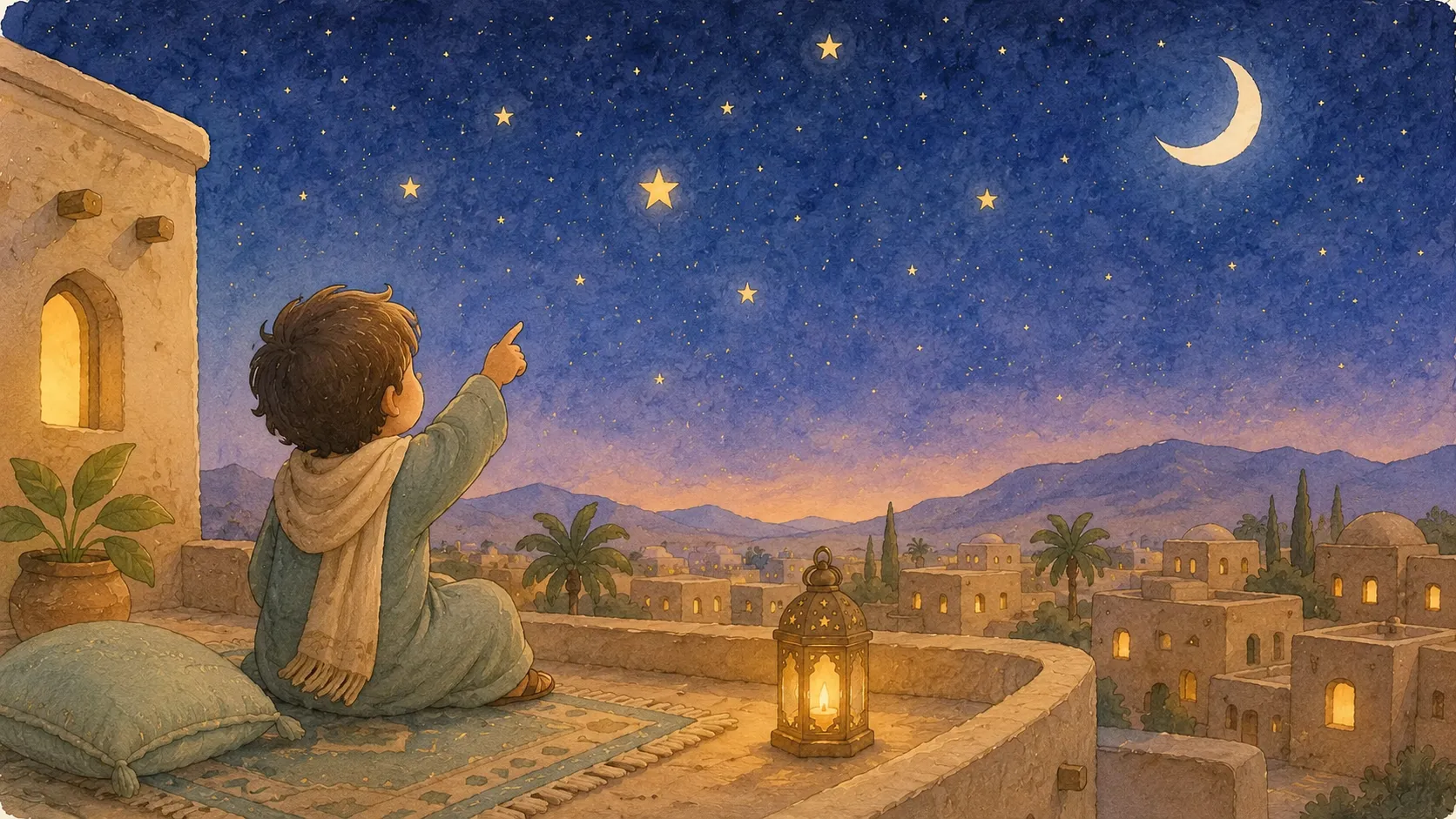
Prophet Ibrahim as a young boy looking up at a starry night sky with crescent moon, illustrating the Quranic story of his journey to understanding the One God
Listen
0:00

Before Ibrahim became a prophet, when he was just a young boy, he lived in a land where the people worshipped many things. They worshipped statues. They worshipped the sun. They worshipped the moon. Ibrahim wondered if any of those things could really be God.

One night, Ibrahim went outside and looked up at the dark sky. He saw a bright, shining star. The star was so beautiful that he wondered:

"Could this be my Lord?"

He watched the star for a long time. But then, slowly, the star moved across the sky and disappeared.

Ibrahim shook his head and said quietly to himself, "I cannot love something that disappears."

Then the moon rose. It was big and round and full of soft silver light. Ibrahim looked up at the moon and wondered:

"Could the moon be my Lord?"

He watched the moon for hours. But just like the star, when morning came, the moon began to fade away.

Ibrahim shook his head again. "The moon goes away too," he said.

Then the sun came up. It was the biggest, brightest thing Ibrahim had ever seen. He thought:

"Surely the sun must be my Lord. It is so bright and powerful."

He watched the sun all day. He watched it move across the sky. And then, in the evening, the sun set too. It disappeared just like the star and the moon.

Ibrahim smiled. Now he understood.

He raised his hands and said: "My Lord is not the star, or the moon, or the sun. My Lord is the One who made them all. The One who never disappears."

That was the day young Ibrahim understood that there is only One Allah. The One who made everything, and who is always there.

What this story teaches us

Ibrahim used his mind to figure out that there is only One Allah, the One who made everything. We can do the same thing. When we look at the sky, the trees, the animals, our own hands, we can think about how amazing Allah is for making all of it. Allah gave us minds so we could think, wonder, and find our way to Him through stories like this one.

From the Quran: Surah Al-An'am (chapter 6), verses 74 to 79. The Quran tells us that Allah showed Ibrahim "the kingdom of the heavens and the earth" so that he would become certain of the truth.

Try it today

Tonight, when it gets dark, go outside if you can and look up at the sky. Find a star, find the moon. Think about who made them, and how amazing Allah is for putting them all in the sky for us to see.

Read more lessons

For Parents

Common questions about Prophet Ibrahim and how to share this story with your child.

Who was Prophet Ibrahim?

Prophet Ibrahim (also known as Abraham in English) was one of the greatest prophets in Islam. He is considered one of the five greatest prophets (the "Ulul Azm"), alongside Nuh (Noah), Musa (Moses), Isa (Jesus), and Prophet Muhammad. Ibrahim is honored as the father of monotheism, and he is the ancestor of both Prophet Muhammad and many of the prophets who came before him.

Ibrahim is mentioned in 25 different chapters of the Quran. He is best known for his unwavering belief in One God, for building the Kaaba in Makkah with his son Ismail, and for his willingness to sacrifice for Allah. Muslims around the world honor Ibrahim during Eid al-Adha, which commemorates his story of obedience and trust in Allah.

Why did Ibrahim look at the stars, moon, and sun?

According to the Quran (Surah Al-An'am 6:74-79), Ibrahim grew up in a society where people worshipped many different things, including statues, the moon, the sun, and the stars. Allah showed Ibrahim "the kingdom of the heavens and the earth" so that he could think carefully about who really deserved to be worshipped.

When Ibrahim saw the star, the moon, and then the sun, he reasoned that none of them could be God, because they all disappear and fade. A true God, he concluded, would never disappear. This is one of the earliest examples in the Quran of using observation and reason to arrive at the truth of tawhid (the oneness of Allah). It teaches that Islam invites thinking, not just blind acceptance.

Where in the Quran is the story of Ibrahim and the stars?

This story is told in Surah Al-An'am, the 6th chapter of the Quran, in verses 74 through 79. Surah Al-An'am means "The Cattle" and contains many stories and teachings about prophethood, the oneness of Allah, and the proper way to worship.

The specific verses describe how Allah showed Ibrahim "the kingdom of the heavens and the earth" (verse 75), and then narrate his reasoning as he observed the star, the moon, and the sun. Verse 79 contains Ibrahim's final declaration: "Indeed, I have turned my face toward He who created the heavens and the earth, inclining toward truth, and I am not of those who associate others with Allah."

Is this story authentic from the Quran?

Yes. This story comes directly from the Quran, in Surah Al-An'am (chapter 6), verses 74 to 79. It is not a folk tale or later tradition. The verses describe how Allah showed Ibrahim "the kingdom of the heavens and the earth" so that he could reach certainty about the truth.

Classical commentators including Ibn Kathir interpret this story as taking place when Ibrahim was a young child, before he became a prophet, working out the truth of tawhid (the oneness of Allah) through his own reasoning. Other interpretations suggest he was older and demonstrating this argument to his people. Both views are within the mainstream tradition.

Was Ibrahim confused about who God was?

This is an important question that parents often have, and it has been thoughtfully addressed by Islamic scholars for centuries. The classical understanding is that Ibrahim was not confused or making mistakes. He was reasoning through the possibilities, walking through what could and could not be God, using his observations of the natural world.

The lesson is the reasoning itself. Anything that appears and disappears, anything that has limits, anything that depends on something else, cannot be the Creator. Ibrahim arrived at this conclusion through his own thinking. The Quran tells the story this way precisely because the reasoning is meant to be followed and learned, not because Ibrahim was uncertain.

How can I use this story with my child?

This story is wonderful for kids who ask big questions. If your child has ever asked "how do we know Allah is real?" or "where is Allah?" then this story models how a young person can reason their way to the answer. It validates their curiosity and shows that Islam invites thinking, not just accepting.

The most natural way to use this story is at night. Take your child outside and look up at the stars together. Ask them what they notice. Let them wonder. The story becomes lived experience when paired with looking up at the same sky Ibrahim looked at long ago.