← Back to Lessons
Lessons from the Quran

The People of the Elephant

The story behind Surah Al-Fil. How Allah protected the Kaaba with small birds.

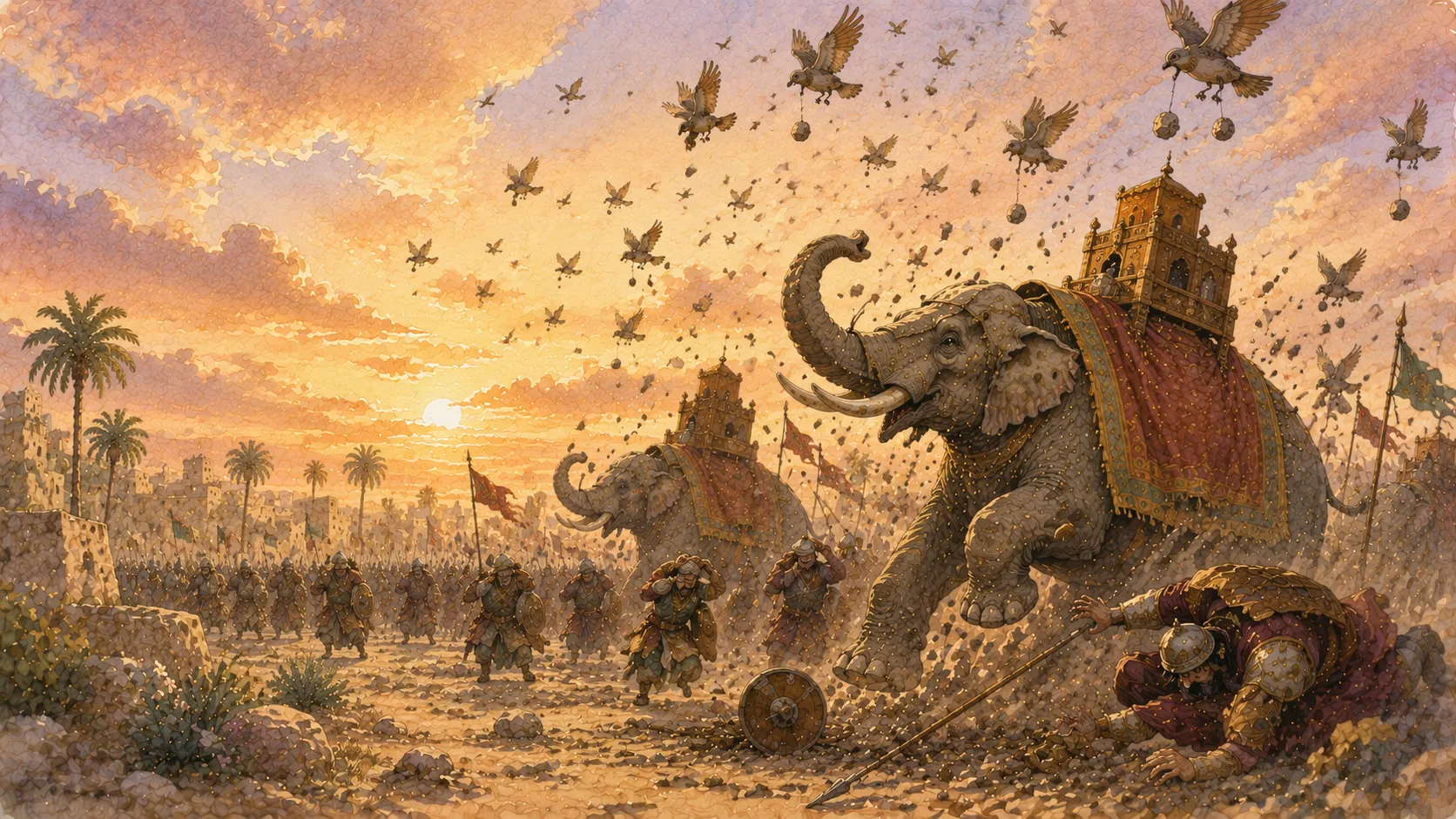
Small birds dropping stones on Abraha’s elephant army to protect the Kaaba, illustrating the Quranic story of Surah Al-Fil and the Year of the Elephant
Listen
0:00

An army was marching toward Makkah. And not just any army. At the front were huge, towering elephants, bigger than anything the people of Makkah had ever seen. The army was on its way to destroy the Kaaba.

How did this happen? It started with a king named Abraha. Abraha lived far away from Makkah, in a different country. He had built a beautiful big church in his land, and he wanted everyone to come visit it.

But people did not come to his church. Instead, they went to Makkah, to a very special place called the Kaaba. The Kaaba was the first house built for the worship of Allah, built long ago by Prophet Ibrahim and his son Ismail.

Abraha became jealous and angry. He decided he would destroy the Kaaba so that everyone would have no choice but to come to his church instead. He gathered a huge army to march to Makkah. And at the front of his army, he brought something the people of Makkah had never seen before: elephants. Big, strong, towering elephants. The biggest one was named Mahmud.

When the army got close to Makkah, the people there became very afraid. What could they do against an army with elephants? They left the city and went up into the hills to watch.

Then something amazing happened. When Abraha tried to make the elephants march toward the Kaaba, the elephants stopped. They knelt down. They would not move. Even when Abraha and his soldiers tried to force them, the elephants refused to walk toward the Kaaba.

And then Allah sent a sign. From the sky, flocks of small birds came flying. Each bird carried tiny stones in its beak and feet. The birds dropped the stones on Abraha's army.

Even though the stones were small, they were sent by Allah. Abraha and his army were destroyed before they could ever touch the Kaaba.

The Kaaba was safe. The people of Makkah came back to their city, amazed at what Allah had done. They named that year the Year of the Elephant. And in that same year, in that same city, the Prophet Muhammad ﷺ was born.

What this story teaches us

When Abraha brought his huge army with elephants, he thought no one could stop him. But Allah used tiny birds with small stones to protect the Kaaba. This story teaches us that nothing is too big for Allah, and nothing is too small for Allah to use. Allah is the protector of what is sacred.

From the Quran: Surah Al-Fil (chapter 105), with historical details preserved in classical seerah works including those of Ibn Ishaq and Ibn Hisham. This event happened in 570 CE, the same year the Prophet Muhammad ﷺ was born.

Try it today

The next time you recite Surah Al-Fil, remember this story. The short surah talks about exactly what happened: the army of the elephant, the birds, the small stones from Allah. Now you know the whole story.

Read more lessons

For Parents

Source, context, and how to share this story with your child.

Who were the People of the Elephant?

The People of the Elephant refers to an army led by King Abraha, the Christian ruler of Yemen, who marched on Makkah around the year 570 CE with the intention of destroying the Kaaba. The army was called "the People of the Elephant" because Abraha brought war elephants with him, an unusual sight on the Arabian Peninsula. The largest elephant was named Mahmud. According to the Quran and classical Islamic histories, Allah sent flocks of small birds (called ababil) carrying tiny stones, which destroyed the army before it could reach the Kaaba. The year of this event is known in Islamic history as the Year of the Elephant.

Why did Abraha try to destroy the Kaaba?

Abraha had built a grand church in Sana’a, the capital of Yemen, and wanted it to be the new center of religious pilgrimage in Arabia. But the Arabs continued to travel to Makkah to honor the Kaaba, which had been built by Prophet Ibrahim and his son Ismail as the first house dedicated to the worship of the One God. According to Islamic tradition, Abraha became jealous and angry that people would not abandon the Kaaba for his church. He gathered a powerful army, including war elephants, and marched on Makkah with the intention of destroying the Kaaba so that people would have no choice but to come to his church.

Where in the Quran is the story of the elephant army?

The story is told in Surah Al-Fil, the 105th chapter of the Quran. The surah is one of the shortest in the Quran, just five verses, but contains the entire story in poetic form. It opens with the question: "Have you not seen what your Lord did to the People of the Elephant?" The surah then describes how Allah turned their plan into ruin, sent flocks of birds against them, and reduced them to chaff. Surah Al-Fil is often one of the first surahs Muslim children learn to memorize, because of its short length, its powerful imagery, and its meaningful place in Islamic history.

What is the source of this story?

The story comes directly from the Quran, in Surah Al-Fil (chapter 105). The fuller historical details, including the name of King Abraha, his elephant Mahmud, and the events leading up to the army’s march on Makkah, are preserved in classical Islamic histories and seerah (prophetic biography) works such as Sirat Rasul Allah by Ibn Ishaq, later edited by Ibn Hisham, and in the major works of Islamic chronicle. The event is also referenced in classical Tafsir (Quranic commentary), particularly by Ibn Kathir and at-Tabari.

Is this a real historical event?

In Islamic understanding, yes, this is a historical event that took place around 570 CE. The Quran refers to it as something the audience would have known firsthand, since the surah was revealed roughly seventy years after the event. Many of the older Arabs of the Prophet Muhammad’s ﷺ generation had grandparents or parents who remembered the Year of the Elephant. Historians outside the Islamic tradition have also documented Abraha as a real ruler of Yemen, and there is archaeological and inscriptional evidence of his existence. The miraculous element, the birds dropping stones, is understood by Muslims as Allah’s direct intervention.

How can I use this story with my child?

This story is wonderful for children who are learning about the Kaaba, about Allah’s protection, or about the wider world the Prophet Muhammad ﷺ was born into. After reading, you might ask: "How do you think the people of Makkah felt when they saw the army with elephants?" or "Why do you think Allah used small birds instead of something big and powerful?" The story pairs especially well with reciting Surah Al-Fil itself, which is short and easy for children to memorize. Once your child knows the story, the surah becomes much more vivid and personal every time they recite it.