← Back to Lessons
Stories of the Prophets Before Muhammad ﷺ

Yunus and the Whale

A prophet, a great whale, and a dua that Allah hears from any darkness.

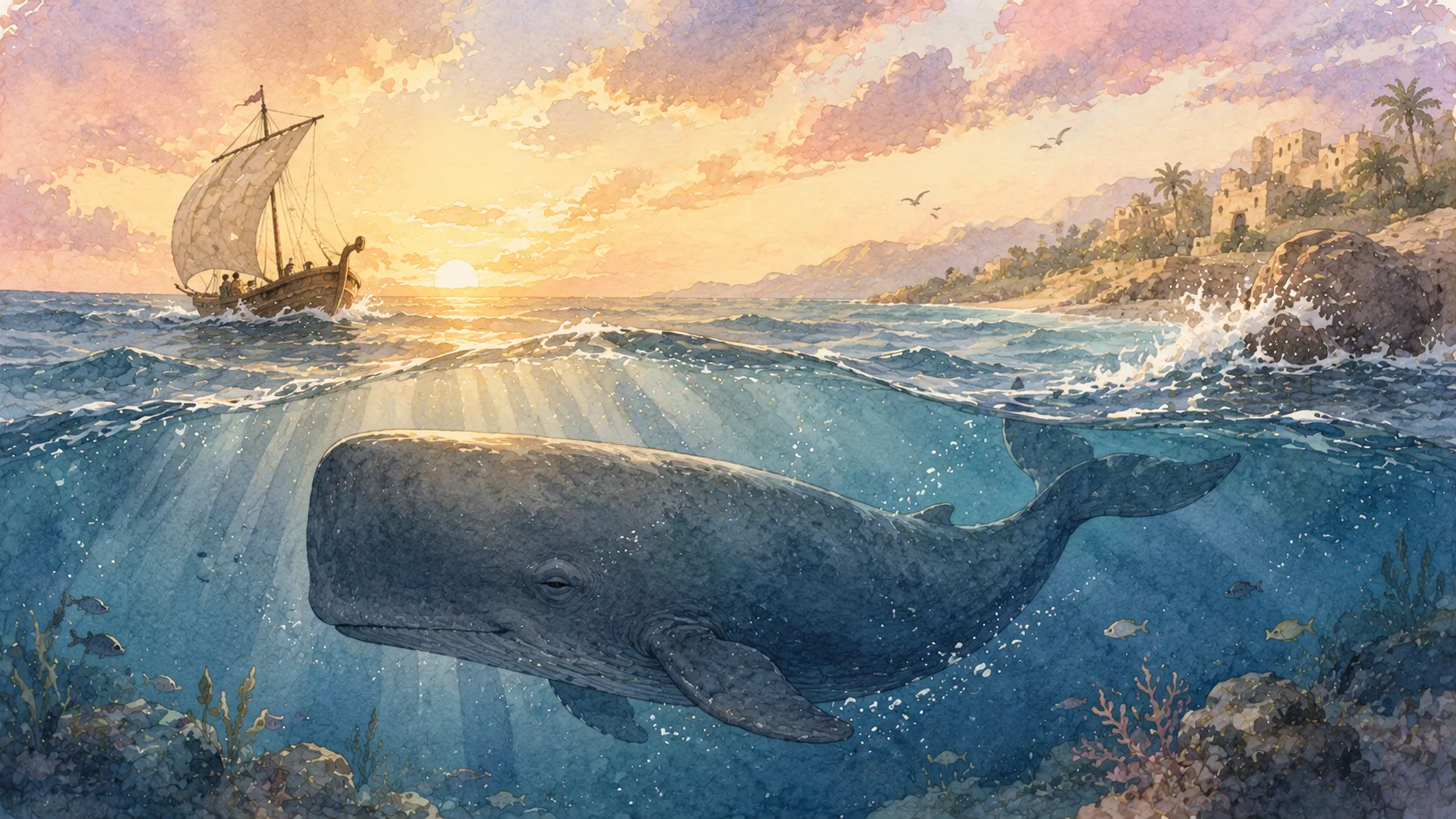
Prophet Yunus and the great whale in a stormy sea at twilight, illustrating the Quranic story of Yunus calling out to Allah from inside the whale
Listen
0:00

A man named Yunus was inside a whale. Inside a whale, inside the deep sea, in three layers of darkness. He had never felt so alone, so afraid, or so far from home. But to understand how Yunus ended up there, we have to go back a little.

Allah had chosen Yunus to be a prophet. Yunus was told to go to a city called Nineveh, where the people did not believe in Allah. He was supposed to teach them about Allah and how to live good lives.

Yunus tried for a long time. He told the people about Allah and asked them to change their ways. But the people did not listen. They laughed at him. They turned away.

After many years of trying, Yunus became frustrated. He left the city without waiting for Allah's permission. He walked to the sea and got on a ship that was sailing away.

While the ship was sailing, a big storm came. The waves grew taller and the ship began to shake. The sailors were afraid the ship would sink. They decided that one person had to jump into the sea to make the ship lighter. Yunus knew he was the one who should leave.

Yunus jumped into the dark, cold water. And just then, Allah sent a great whale that swallowed Yunus whole.

Yunus was inside the whale, in the deep dark sea, in the deep dark belly. Three layers of darkness. He had never felt so alone or so afraid.

Then Yunus remembered Allah. He realized that even though he had made a mistake by leaving Nineveh, Allah was still listening to him. From inside the whale, Yunus called out:

"La ilaha illa anta, subhanaka, inni kuntu mina-thalimeen."

"There is no god but You. Glory be to You. I have done wrong."

Allah heard him. Allah is the One who always hears, even from the deepest darkness. The whale came up to the surface and gently let Yunus out onto a beach. Allah caused a plant to grow over Yunus to give him shade while he got better.

Yunus went back to Nineveh. This time, the people listened. They believed in Allah, and Allah forgave them.

What this story teaches us

When we make a mistake and feel lost in the dark, Allah is still there. Allah hears us from any place, even from the deepest, darkest spot. The dua Yunus said is a beautiful dua we can say when we feel scared, sad, or sorry. Allah is always listening.

From the Quran: Surah Al-Anbiya (chapter 21), verses 87 to 88, and Surah As-Saffat (chapter 37), verses 139 to 148. The dua of Yunus is in Surah Al-Anbiya, verse 87.

Try it today

If you ever feel scared, sad, or sorry for something you have done, you can say the same dua that Yunus said: "La ilaha illa anta, subhanaka, inni kuntu mina-thalimeen." Allah hears it every time.

Read more lessons

For Parents

Source, context, and how to share this story with your child.

Who was Prophet Yunus?

Prophet Yunus (known as Jonah in English) was a prophet sent by Allah to the people of a city called Nineveh, in what is now northern Iraq. The Quran also refers to him as Dhun-Nun, which means "the one of the whale." Yunus is mentioned in several places in the Quran, and his story is one of the most well-known prophetic stories shared across Islam, Christianity, and Judaism. In Islam, Yunus is honored as a sincere prophet whose moment of human frustration led to one of the most beautiful duas ever recorded in the Quran.

Why did Yunus end up inside the whale?

Yunus had been preaching to the people of Nineveh for many years, calling them to believe in Allah. When they refused and mocked him, he became frustrated and left the city without waiting for Allah's permission. He boarded a ship that ran into a fierce storm. The sailors believed someone needed to leave the ship to save it, and Yunus accepted that he was the one. He was thrown into the sea, and Allah sent a great whale to swallow him. The Quran describes this as Yunus being in three layers of darkness: the darkness of the night, the darkness of the sea, and the darkness of the whale's belly. It was there that Yunus turned back to Allah with the dua that has comforted Muslims ever since.

Where in the Quran is the story of Yunus and the whale?

The story of Yunus is told in several places in the Quran. The most detailed accounts are in Surah Al-Anbiya (chapter 21), verses 87 to 88, which describe his dua from inside the whale and Allah's response, and in Surah As-Saffat (chapter 37), verses 139 to 148, which give a fuller narrative of the ship, the sea, and what happened after. Yunus also has a full chapter named after him, Surah Yunus (chapter 10), although that chapter speaks more broadly about prophets and belief than the specific whale incident. His dua, "La ilaha illa anta subhanaka inni kuntu min az-zalimin," is also referenced in hadith collections.

What does the dua of Yunus mean?

The dua Yunus said from inside the whale is "La ilaha illa anta, subhanaka, inni kuntu min az-zalimin." It means: "There is no god but You, Glory be to You, I was certainly among the wrongdoers." This dua is famous for three reasons. It declares Allah's oneness (tawhid), it praises Allah's perfection (tasbih), and it admits one's own mistake (acknowledging wrongdoing). The Prophet Muhammad ﷺ said in a hadith that no Muslim says this dua about a worry of theirs without Allah answering it. It is one of the most beloved short duas in Islam, taught to children early because it captures the heart of what it means to turn back to Allah.

Is this story authentic from the Quran?

Yes. The story of Yunus and the whale is directly from the Quran, in Surah Al-Anbiya (21:87-88) and Surah As-Saffat (37:139-148). It is not a folk tale or later tradition. The Quran describes the events plainly: Yunus left in frustration, was thrown into the sea, was swallowed by a great fish (whale), made his famous dua in the darkness, and was eventually returned to dry land. The story is one of the most well-documented prophetic accounts in the Quran. Hadith collections add the detail of the Prophet Muhammad ﷺ teaching the dua of Yunus to his companions as a powerful supplication for any difficulty.

How can I use this story with my child?

This story is especially powerful for children who are learning that everyone, even prophets, can make mistakes, and that the way back is always open. After reading, you might ask: "Why do you think Yunus left Nineveh?" or "What do you think Yunus felt inside the whale before he made his dua?" The story also teaches children one of the most useful duas in Islam, "La ilaha illa anta subhanaka inni kuntu min az-zalimin," which they can say any time they feel scared, in trouble, or sorry for something they did. The takeaway is gentle and powerful: Allah hears us even from the deepest darkness.