← Back to Lessons
Stories of the Prophet ﷺ

The Mother Bird and Her Chicks

A story about a small mother bird, her babies, and the Prophet ﷺ noticing her sadness.

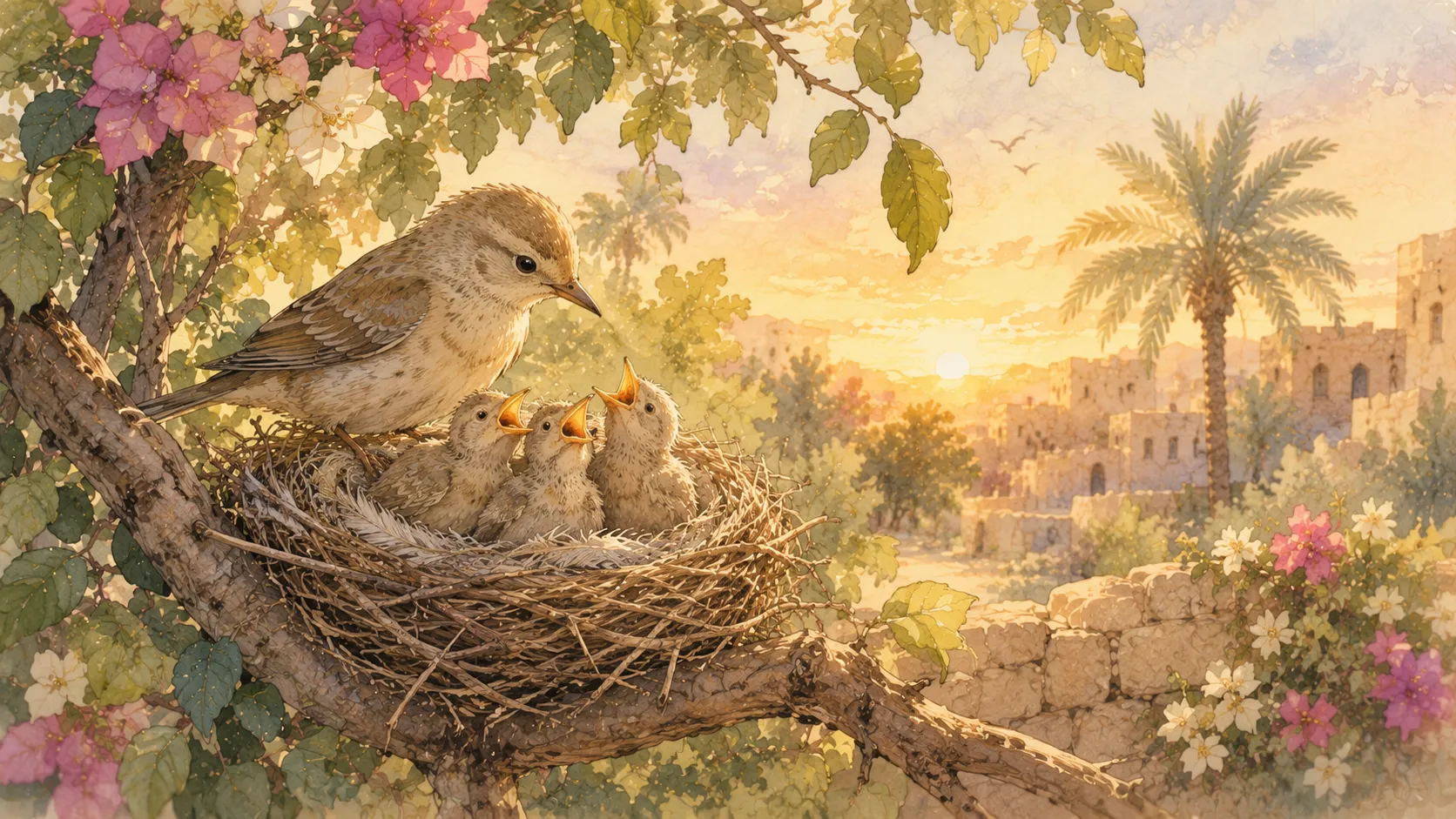
A mother bird returning to her chicks in their nest, illustrating the hadith of the Prophet Muhammad teaching his companions about kindness and mercy to animals
Listen
0:00

One day, the Prophet Muhammad ﷺ and his companions were traveling. They stopped to rest in a quiet, shady place.

While they were resting, one of the companions found a small bird's nest with baby birds inside. He picked up the baby birds, perhaps curious or wanting to look at them more closely.

Just then, the mother bird returned to the nest. When she saw that her babies were gone, she became frantic. She flew in circles above the companions, beating her wings, calling out for her chicks.

The Prophet ﷺ noticed the upset bird right away. He looked at his companions and asked, "Who has hurt this bird by taking her babies?"

The companion who had taken them admitted what he had done. The Prophet ﷺ told him to return the chicks to their nest immediately.

The mother bird calmed down as soon as her babies were back. The Prophet ﷺ used the moment to teach his companions that animals feel just like we do, and that we should never separate a mother animal from her babies.

What this story teaches us

Animals love their babies the same way our parents love us. They feel scared when their families are separated. When we are gentle with animals and their little ones, we are honoring something Allah created with love.

From a hadith narrated by Abdullah ibn Mas‘ud (may Allah be pleased with him), recorded in Sunan Abu Dawud with an authentic chain of narrators.

Try it today

Today, look for a bird in your neighborhood. Watch it for a few minutes without bothering it. Notice how it moves, how it cares for itself, how it lives. Allah created so many kinds of birds and each one has its own family.

Read more lessons

For Parents

Source, context, and how to share this story with your child.

What is the hadith of the mother bird?

The hadith of the mother bird is a famous teaching of the Prophet Muhammad ﷺ about kindness to animals. While the Prophet and his companions were traveling, one of them found a bird's nest and took the baby chicks. The mother bird returned, found her babies gone, and began flying frantically above the companions in distress. The Prophet noticed her right away and asked who had upset the bird by taking her babies. When the companion admitted what he had done, the Prophet told him to return the chicks immediately. As soon as the babies were back in the nest, the mother bird calmed down. The Prophet used the moment to teach that animals feel just like we do, and that we should never separate a mother from her babies.

Why is mercy to animals important in Islam?

In Islam, mercy is a central value of the entire faith. The Prophet Muhammad ﷺ said that Allah is more merciful than any mother to her child, and he taught that the Muslims who are most beloved to Allah are those who show mercy widely, to people and to animals alike. The Quran refers to animals as communities like our own, and the Prophet taught that Allah has prescribed kindness to every living thing. Cruelty to animals is forbidden in Islam, including overworking them, neglecting their food and water, hunting for sport without need, and separating a mother from her young. Mercy to animals is one of the clearest signs of a soft heart in Islam.

Where is the hadith of the mother bird recorded?

The hadith is recorded in Sunan Abu Dawud, one of the six major canonical hadith collections in Sunni Islam, compiled by Imam Abu Dawud as-Sijistani in the 9th century CE. The narration in this lesson comes through Abdullah ibn Mas‘ud (may Allah be pleased with him), one of the earliest and most respected companions of the Prophet Muhammad ﷺ. The hadith is classified as authentic by classical scholars and is widely cited in works on Islamic ethics, animal welfare, and the prophetic biography. It is one of the clearest illustrations of how the Prophet taught compassion to his companions in real-life moments.

What is the source of this hadith?

The story is taken from a hadith narrated by Abdullah ibn Mas‘ud (may Allah be pleased with him) and recorded in Sunan Abu Dawud with an authentic chain of narrators. Hadith collections are records of the sayings and actions of the Prophet Muhammad ﷺ, preserved through chains of trusted narrators across many generations. Sunan Abu Dawud is one of the six major hadith collections in Sunni Islam, compiled in the 9th century CE. The story has been retold for centuries as a teaching about mercy to animals, the importance of noticing the feelings of creatures around us, and the Prophet's gentle way of correcting mistakes.

What does Islam teach about taking animals from the wild?

Islam teaches that animals in the wild belong to Allah and to themselves, and that humans should not disturb them without good reason. Taking baby animals from their parents is specifically discouraged in this hadith and others, because it causes harm and distress to the mother. Hunting for food is permitted with proper conditions, but hunting purely for sport, harming animals for amusement, or taking creatures simply to keep as captives is contrary to the Prophet's teaching. The general principle is that animals should be left in their natural state when possible, and treated with mercy whenever humans interact with them.

How can I use this story with my child?

This story is wonderful for teaching children empathy, especially toward small creatures. After reading, you might ask: "How do you think the mother bird felt when she came back and her babies were gone?" or "Why did the Prophet make the companion return the chicks right away?" The story also opens conversations about how every creature has a family that loves it, just like our own family. If your child has ever wanted to catch a bug, a worm, or a wild creature, this is a gentle way to remind them that the creature might have a family waiting for it too. The takeaway is simple and powerful: every living thing has feelings, and Allah notices how we treat them.