← Back to Lessons
Lessons from the Quran

The Sleepers of the Cave

A few young men refused to worship anything but Allah, hid in a cave — and woke up three hundred years later.

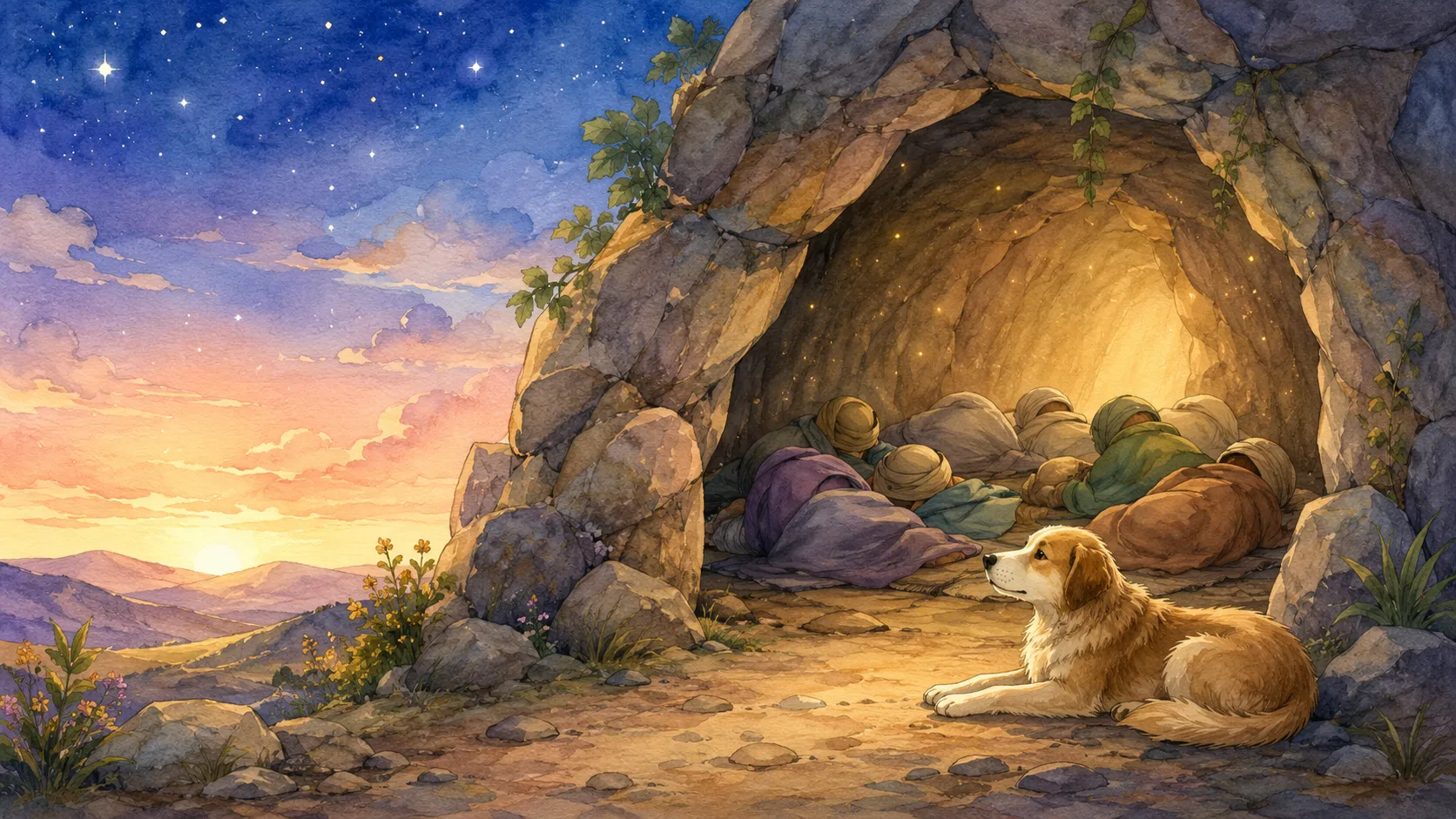
Young men sleeping peacefully under coloured blankets inside a warm cave, with a dog resting at the entrance and a starry sunset sky over the hills outside
Listen
0:00

There is a whole surah in the Quran named after a cave — Surah Al-Kahf, "The Cave." This is the story it is named for.

Long ago, in a city that had forgotten Allah, there lived a small group of young men. Everyone around them bowed to statues. Their king demanded it. But these young men had worked something out for themselves: statues cannot hear, cannot help, and cannot create. Only Allah can.

So they said it out loud. The Quran tells us their words: "Our Lord is the Lord of the heavens and the earth. We will never call upon any god besides Him."

That was a dangerous thing to say. The king would have hurt them, or forced them back to the idols. So they made a choice: they left everything — their homes, their families, their city — and went out to a cave in the hills.

And in the cave they made a dua: "Our Lord, give us mercy from Yourself, and make our situation right." They did not have a plan. They just trusted Allah.

Then Allah did something no one expected. He put them to sleep.

Not for a night. Not for a week. Allah kept them sleeping in that cave for about three hundred years.

And He took care of every detail while they slept. The Quran says the sun moved past their cave so it never burned them. Allah turned them over as they slept, to the right and to the left, so they stayed comfortable. And at the entrance of the cave lay their dog, stretched out with his paws forward, keeping watch. Allah mentions that dog in His Book — that is how carefully He looked after them.

When they finally woke up, they felt like they had napped for a day. One of them went into the city with an old coin to buy food — and everything had changed. The buildings, the people, the money. Nobody worshipped idols any more. The people of that city now believed in Allah.

The young men had gone to sleep as strangers who had to hide. They woke up in a world that agreed with them. And their story went into the Quran forever, so that children like you would know their names were worth remembering, even though we do not know their names at all.

What this story teaches us

These were young people. That is the part not to miss. The Quran calls them fityah — youths — and it says "they were young men who believed in their Lord, so We increased them in guidance." They were the only ones in their whole city who got it right, and being the only one is lonely and frightening. But they said the true thing anyway and left the rest to Allah. And notice how gently Allah cared for them while they slept: even the dog at the door is in His Book.

From Surah Al-Kahf (18) of the Quran, verses 9 to 26.

Try it today

Today, practise being one of them. If everyone around you is doing something you know is wrong — leaving someone out, laughing at someone — you do not have to join in, even if you are the only one. Say the true thing, kindly, and leave the rest to Allah.

Read more lessons

For Parents

Source, context, and how to share this story with your child.

Who were the People of the Cave?

They were a group of young men, called fityah (youths) in the Quran, who lived in a city whose people worshipped idols. They came to believe in Allah alone and refused to worship anything else, which put them in danger from their ruler. They fled to a cave, and Allah caused them to sleep there for a very long time before waking them into a completely changed world. Their story is told in Surah Al-Kahf, verses 9 to 26.

How long did they sleep?

The Quran says they stayed in their cave three hundred years, and adds nine. It then makes a point that is worth teaching children directly: when people argued about exactly how many there were and how long it was, Allah told the Prophet ﷺ to say "My Lord knows best how long they stayed." The surah gently teaches that the details people love to argue about are not the point of the story.

How many sleepers were there, and what about the dog?

The Quran deliberately does not settle the number. It reports people guessing three, five, or seven — and each time adds "the fourth of them their dog," "the sixth of them their dog," "the eighth of them their dog" — then says that only a few truly know, and instructs us not to argue about it. What is striking is that the dog is mentioned every single time. Allah describes it lying at the entrance with its forelegs stretched out, and it is included among them in His Book.

Is this the same as the Christian story of the Seven Sleepers?

There is a well-known Christian tradition of the Seven Sleepers of Ephesus that resembles it, and the Quran's account was revealed in a context where such stories were known and asked about. Muslims take the Quran's telling as the true and authoritative one. Notice that the Quran is not interested in the trivia — it declines to fix the number of sleepers and redirects attention to what actually matters: young people who stood firm for Allah, and Allah's care for them.

Why is Surah Al-Kahf special on Fridays?

It is a well-known practice, based on reports from the Prophet ﷺ, to recite Surah Al-Kahf on Fridays, and there are narrations about a light shining for the one who does. It is a lovely weekly habit to build with children — even reading just the opening verses, which contain this story, and talking about it together on a Friday.

How can I teach this story to my child?

Emphasise their age. Children are used to hearing about prophets and grown-ups; here Allah put a whole surah's worth of attention on a handful of young people who got it right when every adult around them had it wrong. Ask, "Would it be hard to be the only one?" And do not skip the dog — for younger children the dog at the door is the detail they will hold on to, and it is a beautiful way to talk about how closely Allah pays attention.