← Back to Lessons
Lessons from the Quran

The Ant Who Warned Her People

A tiny ant cared enough to warn her people, and a great prophet stopped to listen.

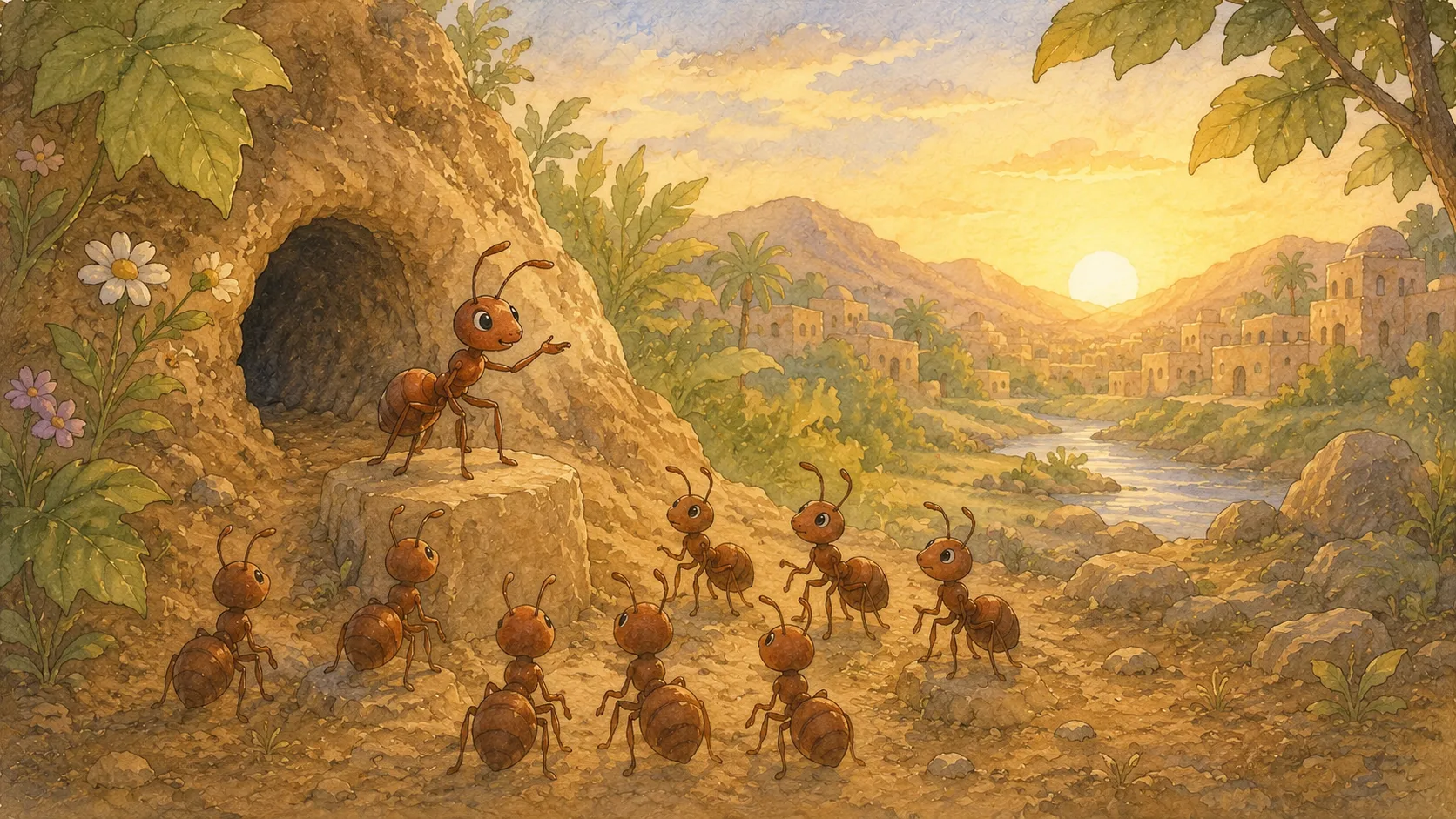
A small ant warning her people in the Valley of the Ants as Prophet Sulaiman’s army approaches, illustrating the Quranic story from Surah An-Naml
Listen
0:00

In a valley once called the Valley of the Ants, something wonderful happened that the Quran still tells us about today.

There was a prophet of Allah named Sulaiman. He was also a king. And Allah had given him a very special gift: Sulaiman could understand the language of animals.

One day, Sulaiman was traveling with his great army through that very valley. There were so many soldiers that the ground shook beneath their feet.

In the valley, there was an anthill. A small ant on the ground saw the army coming. She knew that all those marching feet could crush her people without anyone even noticing.

So she called out to the other ants: "O ants! Enter your homes! Sulaiman and his soldiers might crush you without knowing!"

Far away at the front of the army, Sulaiman heard her tiny voice. He smiled at what she had said.

The army of a great king had been moved by the warning of one small ant.

Sulaiman raised his hands and prayed: "My Lord, help me be grateful for the gift You have given me. Help me do what is good, and let me be among Your righteous servants."

A small ant cared for her people. And a great prophet thanked Allah for being able to hear her.

What this story teaches us

Allah hears every voice, even the smallest. The ant in this story was tiny, but she still cared enough to help her people, and Allah noticed her. When we use our own voices, no matter how small we feel, Allah hears us too. And like Prophet Sulaiman, we can always thank Allah for the gifts we have been given.

From the Quran: Surah An-Naml (chapter 27), verses 18 to 19. The surah is named "An-Naml" which means "The Ant" because of this very story. Classical tafsir on these verses is preserved in the commentaries of Ibn Kathir and at-Tabari.

Try it today

The next time you see an ant or any small creature, take a moment to remember the ant in this story. Every small voice matters. And every gift we have, even small ones, is something we can thank Allah for.

Read more lessons

For Parents

Source, context, and how to share this story with your child.

Who was Prophet Sulaiman?

Prophet Sulaiman (known as Solomon in English) was one of the prophets and kings mentioned in the Quran, the son of Prophet Dawud (David). Allah gave Sulaiman remarkable gifts: he could understand the language of animals and birds, command the wind, and he had authority over the jinn. The Quran honors him as a wise ruler whose kingdom was built on prayer and gratitude. Many of his stories appear in Surah An-Naml, Surah Sad, and Surah Saba’. His name appears in both the Quran and the Hebrew Bible, and he is honored across Islam, Christianity, and Judaism as a great prophet and king.

What does Surah An-Naml mean?

Surah An-Naml means "The Ant," and it is the 27th chapter of the Quran. The surah is named after the small ant whose warning to her people is described in verses 18 and 19. The story is so meaningful that an entire chapter of the Quran carries the ant's name, even though the ant is mentioned only briefly. Surah An-Naml contains many other stories too: the meeting of Prophet Sulaiman with the Queen of Sheba (Bilqis), stories of earlier prophets, and reflections on Allah's signs in creation. The naming of the surah after a single ant's voice is a beautiful reminder that no creature is too small for Allah to notice.

Where in the Quran is the story of the ant?

The story is told in Surah An-Naml (chapter 27), verses 18 and 19. The verses describe how Sulaiman's army marched into the Valley of the Ants, how one ant called out to warn her people to enter their homes, how Sulaiman heard her tiny voice and smiled, and how he then turned to Allah with a beautiful prayer of gratitude. The two verses are short but full of meaning, and they sit near the beginning of a surah that carries the ant's name through more than ninety later verses. Surah An-Naml is one of the most loved surahs for its blend of prophetic stories, miracles, and reflection.

What is the source of this story?

The story comes directly from the Quran, in Surah An-Naml (chapter 27), verses 18 and 19. It is not a folk tale or later tradition. Classical tafsir works (Quranic commentary) by scholars such as Ibn Kathir and at-Tabari provide additional context, including the Valley of the Ants being identified by some commentators as a specific place in the Arabian Peninsula or Greater Syria. The story is referenced widely in Islamic ethical literature as an example of how Allah notices and responds to the small voices of His creation.

Did Sulaiman really understand animals?

Yes. According to the Quran, Allah gave Prophet Sulaiman the miraculous gift of understanding the speech of animals and birds. Surah An-Naml (27:16) says: "Sulaiman inherited from Dawud, and he said: O people, we have been taught the speech of birds." This is one of the unique miracles given to Sulaiman, alongside command over the wind, work of the jinn, and great wealth and wisdom. Other prophets also had unique miracles given to them by Allah, such as Musa's staff that turned into a serpent and Isa's ability to heal the sick. In Islamic understanding, each prophet's miracles are signs from Allah and proofs of their prophethood, not tricks or magic.

How can I use this story with my child?

This story is wonderful for children learning that small voices matter. The ant was tiny, but her words mattered enough to be recorded in the Quran for all time. After reading, you might ask: "Why do you think the ant cared so much about warning the other ants?" or "Why do you think Sulaiman smiled when he heard her?" The story is also a beautiful entry point for talking about gratitude, since Sulaiman's response was not pride at being able to hear the ant, but a heartfelt prayer thanking Allah for the gift. You can teach your child that whether they are small or great, their voice matters, and that gratitude is what makes great gifts feel meaningful.