العلق
Al-Alaq
The first words of the Quran ever revealed. In a cave on a mountain, an angel told a man who could not read: Read. This is the surah that started everything.
▶ Listen fullListen, read, and learn
In the name of Allah, the Most Gracious, the Most Merciful.
Read! In the name of your Lord who created —
created the human being from a clinging form.
Read! And your Lord is the Most Generous,
the One who taught by the pen,
taught the human being what they never knew.
But no — a person goes too far,
as soon as they think they need no one.
Truly, everything returns to your Lord.
Have you seen the one who tries to stop
a servant of Allah when they pray?
What do you think — what if that servant is guided,
or is telling people to be mindful of Allah?
And what if the one stopping him denies the truth and turns away?
Does he not know that Allah sees?
No indeed! If he does not stop, We will seize him by the forehead —
a lying, sinful forehead.
So let him call his gang —
We will call the angels of punishment.
No indeed! Do not obey him. Bow down in prostration, and come close to Allah.
Verse meanings adapted for young readers · full translation at Quran.com
What this symbol means
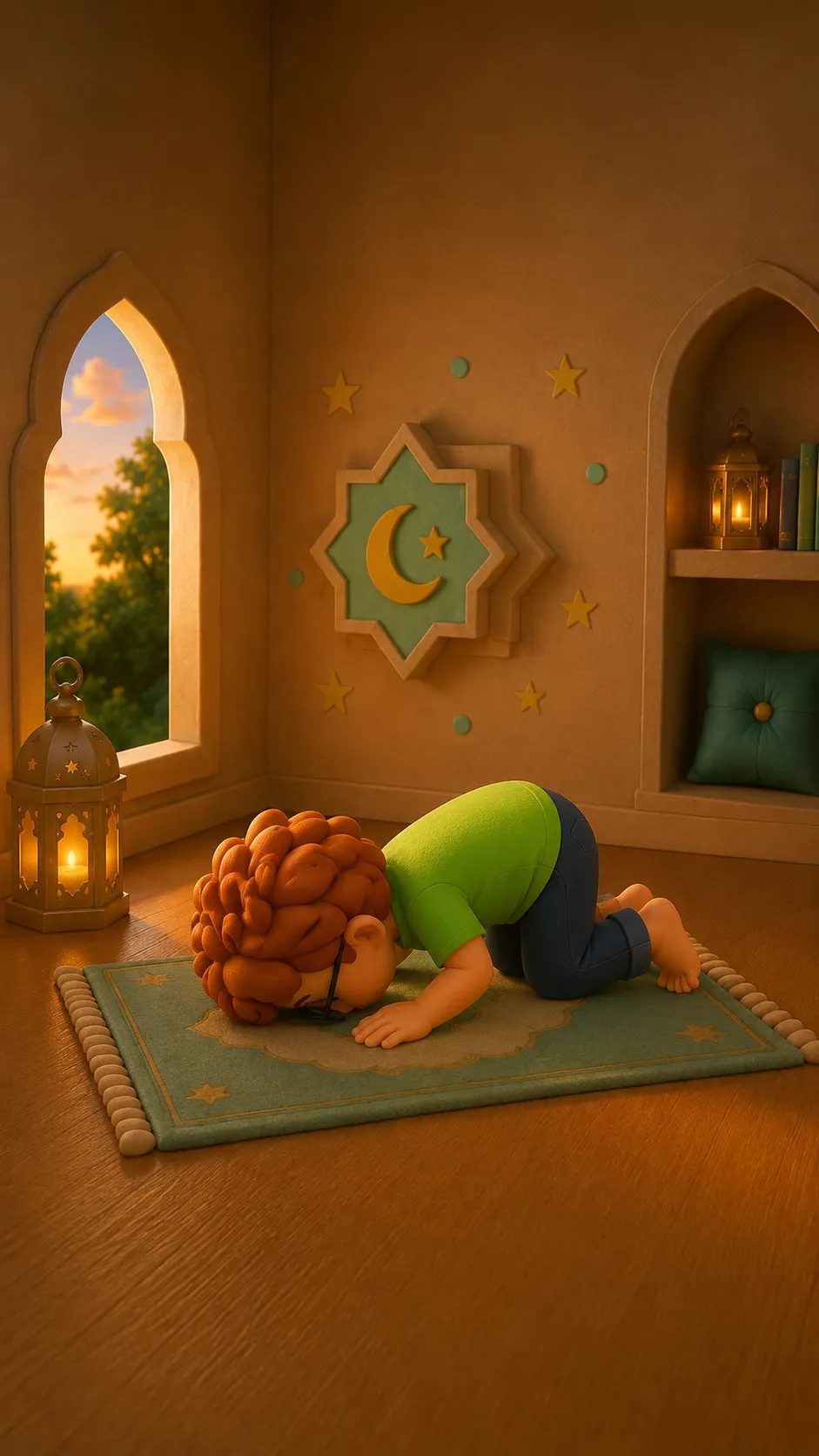
The last verse of Al-Alaq says “bow down in prostration.” When a Muslim reads or hears it, they make one sajdah — the same position as in prayer, forehead on the ground. It is called sajdat at-tilawah, the prostration of recitation. You will see the mark at this spot in a printed Quran too.
It is simple: go down into sujood, say the words below once, and come back up. There is no takbir needed to begin, no tashahhud, and no salam at the end — it is a single prostration, not a prayer.
سُبْحَانَ رَبِّيَ الْأَعْلَى Subhana Rabbiyal-A'la Glory to my Lord, the Most HighYour child may already know those words — they are what we say in every sujood, and they open Surah Al-A'la. If they are somewhere they cannot prostrate right now, that is fine: many scholars hold this sajdah is recommended rather than required, so it can be done later.
About Al-Alaq
Of all the surahs in this section, this one has the most extraordinary story. The Prophet Muhammad ﷺ was alone in a cave on a mountain outside Mecca, thinking quietly, when the angel Jibril came to him and said one word: Iqra — Read. He answered honestly that he did not know how to read. The angel held him and said it again. And then came the first five verses of this surah, the very first words of the Quran ever sent down.
Think about which word Allah chose to begin with. Not a rule. Not a warning. A command to read, learn, and know — in the name of the Lord who created. And straight after, Allah calls Himself the Most Generous, and says He is the One who taught by the pen, who taught the human being what they did not know. Every letter your child learns is part of that.
The middle of the surah turns to a different problem. A person starts to go too far when they think they do not need anyone — when they feel rich enough, clever enough, strong enough to manage without Allah. That is the moment things tip over. Then it asks about someone who actually tried to stop a servant of Allah from praying. Does that person not realise that Allah sees?
And the surah ends with a command to come closer: do not obey him — bow down and draw near. The last verse is a verse of prostration.
The final verse of Al-Alaq is one of the Quran’s verses of sajdah. When a Muslim recites or hears it, they make a single prostration — sajdat at-tilawah. If your child learns this surah, teach them the ending properly: the surah that begins with “Read” finishes by putting our foreheads on the ground.
Read the story of the cave of Hira →Surahs paired with Al-Alaq
These short surahs teach lessons close to Al-Alaq:
For Parents
What does Al-Alaq mean?
Al-Alaq (العلق) refers to the clinging form that every human being grows from at the very start of life. It comes from verse 2, which says Allah created the human being from alaq. The surah is also widely known simply as Iqra — “Read” — after its first word.
Why is Surah Al-Alaq so important?
Its first five verses were the first revelation of the Quran ever given to the Prophet Muhammad ﷺ, brought by the angel Jibril in the cave of Hira. Everything else in the Quran came after these words. That makes this surah the beginning of the entire revelation.
How long is Surah Al-Alaq?
Al-Alaq is nineteen verses long and takes about a minute to recite. It is the 96th surah of the Quran and was revealed in Mecca. The famous opening five verses are short and are often the first part children learn, before completing the rest.
Why does the surah end with a prostration?
The final verse commands “bow down and draw near.” It is one of about fifteen verses of prostration in the Quran, so a Muslim who recites or hears it performs a single sajdah. It is a beautiful ending: a surah that opens by telling us to read closes by telling us to put our heads to the ground.
What does “when he sees himself as self-sufficient” mean?
Verses 6 and 7 say a person goes too far when they think they need nobody. Wealth, cleverness or strength can quietly convince someone they are managing alone. For children this translates well into everyday terms: it is exactly when we feel we are the best at something that we most need to stay humble and grateful.
How can my child memorize Al-Alaq?
Learn the first five verses on their own first — they are short, famous, and worth knowing even by themselves. Then add verses 6–8 and 9–14 as two short blocks, and finish with 15–19. Tell the story of the cave alongside it; children memorize far faster when the words carry a story they already love.